How-to · Air Fryers
How to Choose a Budget Air Fryer: Size, Wattage, Basket vs Oven

Short answer: For most kitchens, a basket-style air fryer of 4 to 6 quarts (about 4 to 5.5 liters), with a dial or simple digital controls, a dishwasher-safe basket, and a temperature range up to at least 400 °F (200 °C), is all you need. Pay for size and a good basket, not for presets or an app.
This guide covers what the numbers on the box mean, so you can tell a good cheap air fryer from a bad one before you buy.
Start with size, not price
Size is the one choice you cannot fix later. An air fryer only crisps well when the food sits in a single layer with air moving around it, so a basket that is too small means cooking in batches, and the second batch is always eaten after the first one has gone cold.
| Basket size | Fits | Good for |
|---|---|---|
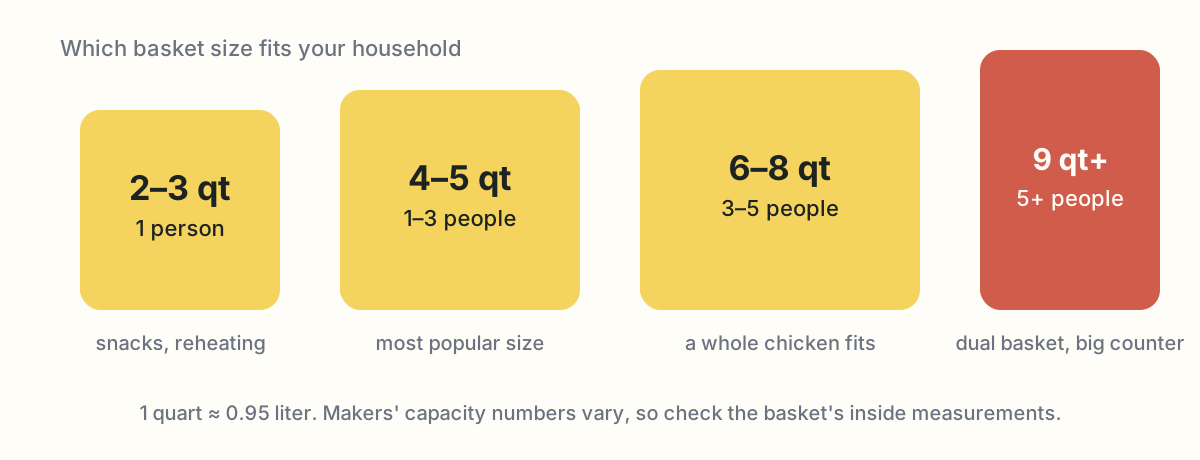
| 2 to 3 quarts (2 to 3 L) | 1 person | Reheating, snacks, a single chicken breast |
| 4 to 5 quarts (4 to 5 L) | 1 to 3 people | The most common size; a pound of fries or four pieces of chicken |
| 6 to 8 quarts (5.5 to 7.5 L) | 3 to 5 people | A whole small chicken, a full tray of vegetables |
| 9 quarts and up, or dual basket | 5 or more | Two foods at once; needs a lot of counter space |
Two things to know about the number on the box:
- Makers measure capacity differently. One brand’s “5 quart” basket can hold less than another’s. If you can, check the basket’s inside width; a flat basket about 8 inches (20 cm) across is a real four-person size.
- A bigger air fryer is not always better. It takes longer to heat, uses more counter space, and a half-empty large basket crisps less well than a full small one.
Basket vs oven style
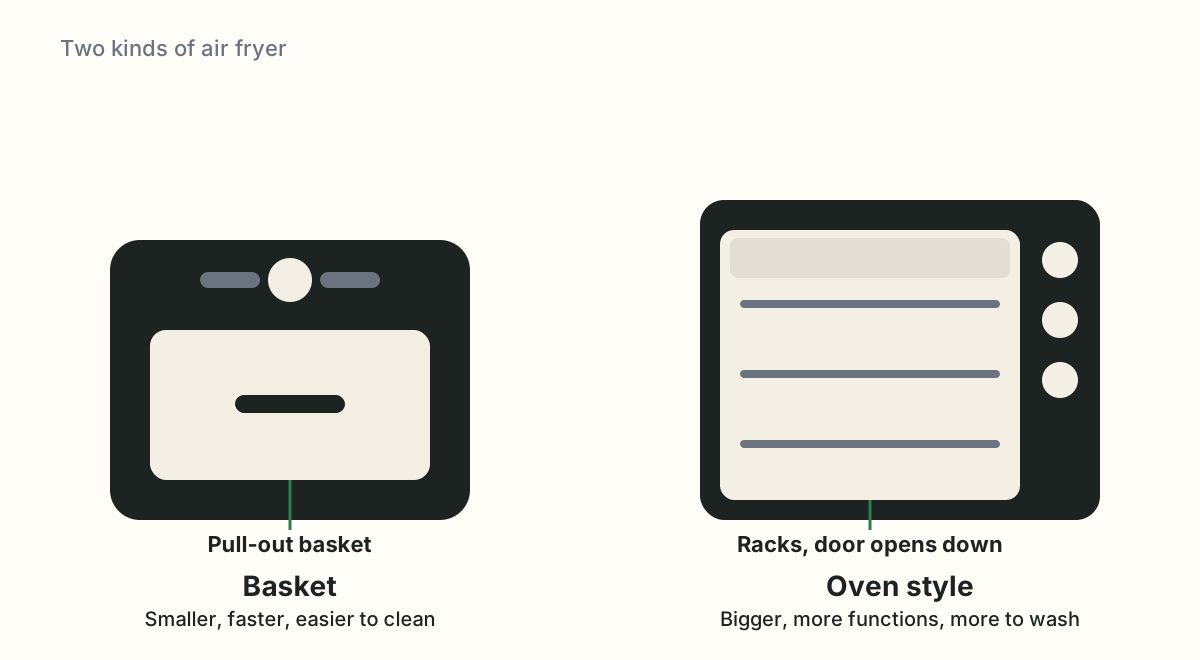
Basket air fryers have a drawer you pull out to shake the food. They heat quickly, take up less space, and have one basket and one tray to wash. For most people, and almost every budget, this is the one to buy.
Oven-style air fryers look like a small toaster oven with racks and a door. They hold more, can toast and bake, and let you see the food. The trade-offs: they cost more, take longer to heat, and you cannot shake the food, so pieces near the heating element brown faster than the rest. They also come with more parts to wash.
If you already own a toaster oven, a basket air fryer adds something new. If you own neither and have the counter space, an oven-style model can replace both, but expect to pay more than the cheapest basket models.
Wattage and temperature
Most budget air fryers between 4 and 6 quarts are rated at 1,400 to 1,800 watts. Within that range, wattage tells you little about cooking results; the fan and the shape of the basket matter more. What wattage does tell you:
- Your outlet. 1,700 watts and above is close to the limit of a standard household circuit in the US. Do not run a high-wattage air fryer on the same circuit as a microwave or kettle at the same time, or you will trip the breaker.
- Heat-up time. Higher wattage heats a little faster, but the difference is a minute or so.
For temperature, check the top of the range. Many cheap models stop at 400 °F (200 °C), which is enough for everything. A few stop at 360 °F or 390 °F, which makes crisping slower. Also look for a low end around 170 °F (80 °C) if you want to reheat or dehydrate.
Controls: dials or buttons
Dials (one for temperature, one for time) are the cheapest, the easiest to use, and the hardest to break. Their only weakness is precision: a dial marked in 25-degree steps is a guess.
Digital controls let you set exact temperatures and times, and usually remember the last setting. Budget digital models are fine; the things to check are that the display is readable from above and that the buttons respond to a light touch. Flush touch panels on cheap models can be slow to register.
Presets (a button with a picture of a shrimp or a drumstick) are a saved time-and-temperature pair. They are not a reason to pay more. After you have cooked a food twice, you will know its setting better than the preset does.
The basket: coating, shape and cleaning
This is where cheap air fryers differ most, and it is worth looking at closely.
- Coating. Nearly all budget baskets are non-stick coated aluminum. The coating is the part that fails first on cheap models: it can chip or peel after months of scrubbing. A basket you can buy a replacement for is a plus; check whether the maker sells spare baskets.
- Removable crisper plate. Most baskets have a perforated plate that lifts out. Look for one that comes out easily without tools, because that is the part that gets greasy.
- Shape. A square basket holds more flat food than a round one of the same quart rating.
- Dishwasher safe. Most are, but the coating lasts longer if you hand wash. Either way, make sure the basket and plate are the only parts that need washing; models with a fixed drip tray above the basket are a pain.
Features worth paying for, and not
Worth it
- A basket size that fits your household (see above).
- A temperature range that reaches 400 °F (200 °C).
- A window or a basket that is easy to pull out and check mid-cook.
- A shake reminder, if you tend to walk away.
- A replaceable basket.
Not worth extra money on a budget model
- Presets.
- App control. You still have to put the food in and take it out.
- Stainless-steel exterior. Nice to look at, no effect on cooking.
- “Rapid air” and similar trademarks. Every air fryer moves hot air fast; that is what it is.
- Very high wattage claims.
Noise, smell and space
- Noise. Air fryers are a fan in a box, so all of them hum. Louder cheap models sound like a hair dryer on low; it is normal and not a sign of a fault.
- First-use smell. Many new air fryers give off a plastic or chemical smell the first time or two. Run the empty basket at full heat for 10 to 15 minutes in a ventilated room before cooking in it. If the smell persists after several uses, that is a reason to return it.
- Space. Measure your counter and the height under your cabinets. Air fryers vent hot air from the back or sides, so leave a few inches of space around them and keep them away from the wall and from cabinets above.
Safety marks and warranty
Check that the product carries a safety mark from a recognized testing lab: UL or ETL in the US, CE and UKCA in the UK, and the equivalent in your country. Listings that show no mark at all, or that name one in text without a logo on the product, are a reason to pick something else.
Most budget air fryers come with a one-year warranty. Read how it works: some require you to ship the unit back at your own cost, which can be close to the price of a cheap one.
A quick checklist before you buy
- Basket size matches your household.
- Basket style (not oven style), unless you need to toast and bake too.
- Reaches 400 °F (200 °C).
- Dial or simple digital controls; ignore presets.
- Crisper plate lifts out; basket is dishwasher safe; spare baskets sold.
- Safety mark from a recognized lab.
- It fits your counter with room to vent.
If a cheap air fryer ticks these seven, the price difference to a more expensive one buys you looks and features, not better food.
FAQ
What size air fryer do I need for a family of four?
A 6 to 8 quart (about 5.5 to 7.5 liter) basket is the usual fit for three to five people. It cooks a whole small chicken or a tray of fries in one batch. Anything under 5 quarts means cooking in two rounds.
Does wattage matter in an air fryer?
Less than you would think. Most 4 to 6 quart air fryers run between 1,400 and 1,800 watts and all get hot fast. What matters more is how evenly the air moves around the food, and that does not show on the box.
Is an air fryer just a small convection oven?
Essentially yes. It is a compact oven with a strong fan. The small space and fast air are why food crisps faster than in a full-size oven, and why a big oven-style air fryer behaves more like a regular oven.
Are the cheapest air fryers safe?
Look for a safety mark from a recognized testing lab (UL or ETL in the US, CE and UKCA in the UK and Europe). Beyond that, the common failures in cheap models are a peeling basket coating and a plastic smell in the first uses, not fires.
Do I need presets?
No. Presets are just saved time-and-temperature pairs. Two dials, one for temperature and one for time, do everything a preset button does once you have cooked a thing twice.