How-to · Coffee
How to Make Cold Brew Coffee at Home (No Special Equipment)

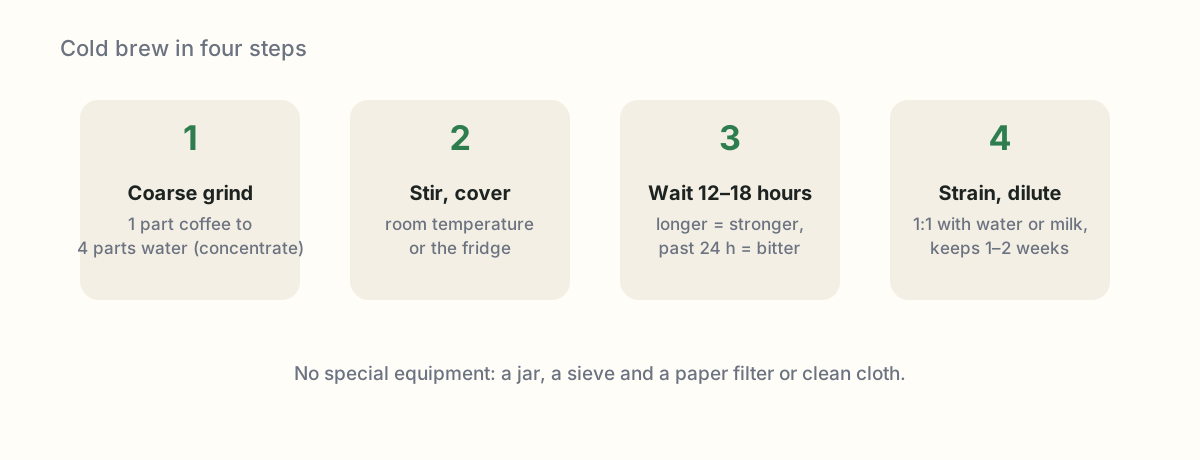
Short answer: Mix coarse-ground coffee with cold water at a ratio of 1 part coffee to 4 or 5 parts water (by weight), stir, cover, and leave it for 12 to 18 hours. Strain through a sieve lined with a paper filter or a clean cloth. You now have a concentrate; dilute it half and half with water, milk or ice to drink. It keeps for a week or two in the fridge.
You do not need a cold brew maker. A jar does the job. A French press does it too and strains for you.
Why cold brew tastes different
Hot water pulls acids and bitter compounds out of coffee quickly. Cold water pulls them out slowly and incompletely, so what you get after a long steep is the sweet, chocolatey part of the coffee with much less acidity. That is why cold brew tastes smooth, and why people who find hot coffee harsh on the stomach often do fine with it.
The trade-off is that cold brew flattens the bright, fruity notes of light roasts. Medium and dark roasts suit it best, and cheap coffee tastes better as cold brew than it does hot.
The ratio
Cold brew is usually made as a concentrate and diluted to taste.
| Style | Coffee : water (by weight) | Example | Then |
|---|---|---|---|
| Concentrate (standard) | 1 : 4 | 100 g coffee, 400 g water | Dilute 1:1 |
| Concentrate (lighter) | 1 : 5 | 100 g coffee, 500 g water | Dilute 1:1 |
| Ready to drink | 1 : 8 | 60 g coffee, 480 g water | Pour over ice |
No scale? A level cup of coarse grounds is roughly 80 g, so one cup of coffee to four cups of water makes a standard concentrate. Our coffee-to-water ratio chart covers other brewers.
Step 1: Grind coarse
Grind the beans coarse, like coarse sea salt or breadcrumbs. Coarse grounds are easier to strain and give a cleaner, less bitter result over a long steep. Pre-ground coffee works but is finer; expect to strain more carefully.
Step 2: Combine and stir
Put the grounds in a large jar or pitcher, add cold or room-temperature water, and stir until every ground is wet. Dry clumps floating on top will not extract. Filtered water tastes noticeably better here, because there is nothing to hide the water’s flavor.
Step 3: Steep
Cover and leave for 12 to 18 hours. On the counter is faster; in the fridge takes a few hours longer and some people prefer the result. There is no need to stir again.
Taste at 12 hours. If it is thin, go longer. Past about 24 hours, the brew turns woody and bitter, so set a timer or write the time on the jar.
Step 4: Strain
Strain twice:
- Pour through a fine mesh sieve into a clean container to catch the grounds.
- Pour that through a paper coffee filter, a clean thin cloth, or a nut-milk bag to catch the fine sediment. This second strain is what makes the difference between a clean glass and a muddy one.
A French press skips step one: steep in the press, plunge, and pour through a paper filter.
Step 5: Dilute and serve
Concentrate is too strong to drink straight. Mix roughly 1:1 with cold water, milk or a plant milk, over ice. Adjust until it tastes right; some people like 1:2. For a hot cup, dilute with hot water instead.
Storage
Keep the concentrate in a sealed jar in the fridge. It is best within a week and fine for two. Diluted cold brew, or cold brew with milk, lasts a couple of days. If it tastes sour or flat, it is past its best.
Making it better
- Use fresher beans. Cold brew hides flaws, but stale coffee still tastes stale.
- Try a medium or dark roast. They suit the method best.
- Add a pinch of salt to the concentrate if it tastes slightly bitter; it rounds it out.
- Make ice cubes from leftover cold brew so iced coffee does not dilute into water.
Equipment, if you want it
A dedicated cold brew pitcher with a mesh insert saves the straining step. It is a convenience, not a necessity, and the mesh inserts let fine sediment through, so you may still want a paper filter at the end. A large French press is the best cheap option because it steeps and strains in one container.
FAQ
What is the ratio for cold brew?
For a concentrate, 1 part coffee to 4 or 5 parts water by weight (for example 100 g coffee to 450 g water), then dilute 1:1 with water or milk to drink. For ready-to-drink strength, brew at 1:8 and skip the dilution.
How long should cold brew steep?
12 to 18 hours. Twelve is lighter and brighter; eighteen is heavier. Past 24 hours it starts to taste woody and bitter. Steep on the counter for a faster brew, or in the fridge, which takes a few hours longer.
Is cold brew stronger than regular coffee?
The concentrate is much stronger. Once diluted to drinking strength, a glass of cold brew usually has a little more caffeine than a cup of drip, because the ratio is higher, but it is in the same range. It tastes smoother because cold water extracts less acid.
Can I use pre-ground coffee for cold brew?
Yes, though it will be finer than ideal. It works; strain through a paper filter at the end to catch the fine sediment. Coarse-ground is better and strains more easily.
How long does cold brew keep?
Concentrate keeps for one to two weeks in a sealed jar in the fridge. It is best in the first week. Diluted cold brew keeps for a couple of days.
Can I heat cold brew?
Yes. Dilute the concentrate with hot water instead of cold for a smooth, low-acid hot coffee. It will not taste the same as hot-brewed coffee, but many people with sensitive stomachs prefer it.