How-to · Coffee
Coffee Grind Size Chart: The Right Grind for Every Brew Method

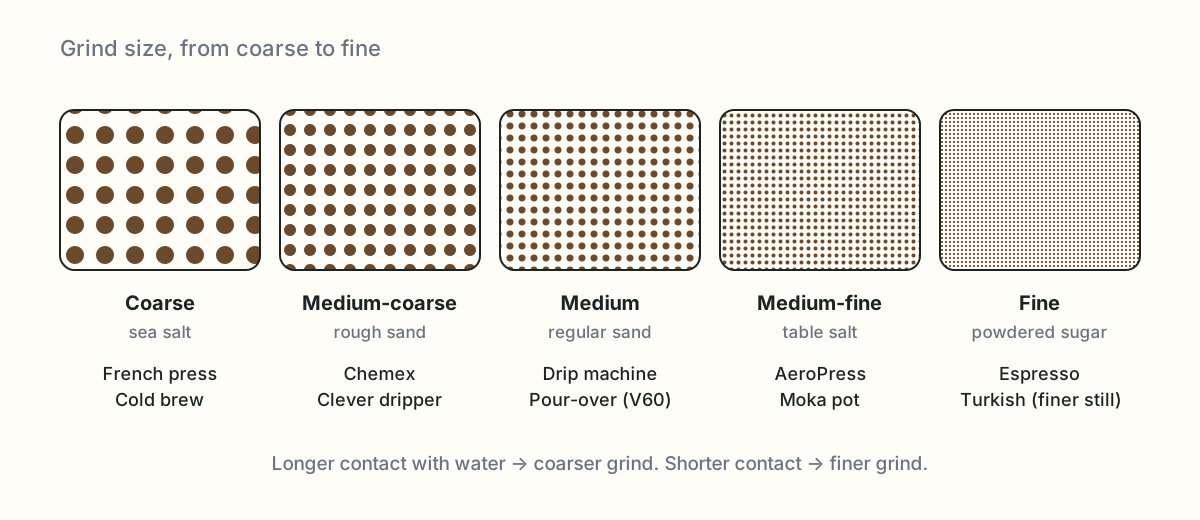
Short answer: The longer the coffee sits in water, the coarser the grind should be. Cold brew and French press use a coarse grind; drip and pour-over use medium; AeroPress and moka pot use medium-fine; espresso uses fine. If your coffee tastes bitter, grind coarser. If it tastes sour or weak, grind finer.
That one rule explains the whole chart. Here it is in detail, with how each grind should look and feel, and how to adjust when a cup does not taste right.
The chart
| Brew method | Grind size | Looks like | Contact time |
|---|---|---|---|
| Cold brew | Extra coarse | Cracked peppercorns | 12 to 24 hours |
| French press | Coarse | Coarse sea salt, breadcrumbs | 4 minutes |
| Clever dripper, Chemex | Medium-coarse | Rough sand | 3 to 5 minutes |
| Drip machine | Medium | Regular sand | 4 to 6 minutes |
| Pour-over (V60, Kalita) | Medium to medium-fine | Sand, a little finer | 2.5 to 4 minutes |
| AeroPress | Medium-fine | Table salt | 1 to 2 minutes |
| Moka pot | Medium-fine to fine | Finer than table salt, not powder | 2 to 4 minutes |
| Espresso | Fine | Powdered sugar, slightly gritty | 25 to 30 seconds |
| Turkish | Extra fine | Flour | Boiled with the water |
These are starting points. Grinders differ, beans differ, and your taste decides. Start at the chart’s setting, taste, then adjust one step at a time.
Why contact time decides the grind
Water pulls flavor out of coffee from the surface of each particle. Fine grounds have far more surface area than coarse ones, so they give up their flavor quickly. Coarse grounds give it up slowly.
A brew method that keeps the coffee in water for a long time (French press, cold brew) needs coarse grounds, or it over-extracts and turns bitter. A method where the water passes through in seconds (espresso) needs fine grounds, or the water runs through before it has taken much flavor, and the cup is weak and sour.
So: long contact, coarse. Short contact, fine. Everything in between follows.
How to tell if your grind is wrong
You do not need to see the grind to know it is off; the cup tells you.
| The coffee tastes | Likely cause | Fix |
|---|---|---|
| Bitter, harsh, dry on the tongue | Too fine (over-extracted) | Grind coarser |
| Sour, thin, weak, “watery” | Too coarse (under-extracted) | Grind finer |
| Bitter and sour | Uneven grind (fines and boulders together) | Better grinder, or sift; a burr grinder fixes this |
| Muddy, with sludge (French press) | Too fine for a mesh filter | Grind coarser |
| Pour-over drains very slowly or stalls | Too fine | Grind coarser |
| Pour-over drains in under two minutes | Too coarse | Grind finer |
| Espresso shot runs fast and pale | Too coarse | Grind finer |
| Espresso shot drips or chokes | Too fine | Grind coarser |
Change the grind, keep everything else the same, and taste again. One variable at a time.
Blade vs burr grinders
A blade grinder chops beans with a spinning blade, like a small blender. The result is a mix of powder and large chunks, and the longer you run it, the finer the average gets, but it never gets even. It is fine for French press and drip if you pulse in short bursts and shake it between pulses. It cannot produce a usable espresso grind.
A burr grinder crushes beans between two ridged surfaces set a fixed distance apart, so every particle comes out close to the same size. That evenness is what makes the cup taste clean rather than bitter and sour at the same time. Budget hand burr grinders cost about the same as a cheap electric blade grinder and produce a far better grind; the trade-off is a minute of cranking per cup.
If you buy one piece of coffee equipment, make it a burr grinder. It improves every brew method more than a better brewer does.
Pre-ground coffee
Most bagged ground coffee is a medium grind, intended for drip machines. It works well for drip and acceptably for pour-over and AeroPress. It is too fine for a French press (expect sediment and some bitterness) and far too coarse for espresso. Some brands sell coarse “French press” grinds and fine “espresso” grinds; read the bag.
Ground coffee also goes stale within days of grinding, as the huge surface area lets aroma escape. If you can only afford one upgrade, buying whole beans and a cheap hand grinder usually makes a bigger difference than buying more expensive pre-ground coffee.
Grind fresh, grind just enough
Grind right before brewing, and grind only what you need. Whole beans stay fresh for weeks in a sealed container away from light and heat; ground coffee fades in days. The freezer is fine for long storage of whole beans if they are in an airtight container and you take out only what you need without letting the rest thaw and refreeze.
FAQ
What grind size for a French press?
Coarse, like coarse sea salt or breadcrumbs. Finer grounds slip through the mesh filter and make the cup muddy and bitter.
What grind size for pour-over?
Medium, like regular sand. Go a little finer for small single-cup cones and a little coarser for large ones. If the brew takes much longer than four minutes, grind coarser.
What grind size for a drip coffee maker?
Medium. This is what most pre-ground coffee is sold as, so standard store-bought ground coffee works in a drip machine without adjustment.
What grind size for espresso?
Fine, like powdered sugar or slightly coarser. Espresso is the one method where a cheap blade grinder will not do; you need a burr grinder with fine adjustment, because a small change makes a big difference to the shot.
Can I use one grind size for everything?
You can get by with medium for drip, pour-over and AeroPress. It will be too fine for French press (sediment, bitterness) and far too coarse for espresso (weak, fast shots).
Does grind size matter more than the coffee?
For getting the most out of good coffee, the grind matters as much as the beans. The wrong grind makes expensive coffee taste bad; the right grind makes ordinary coffee taste noticeably better.