How-to · Coffee
How to Descale a Coffee Maker or Espresso Machine

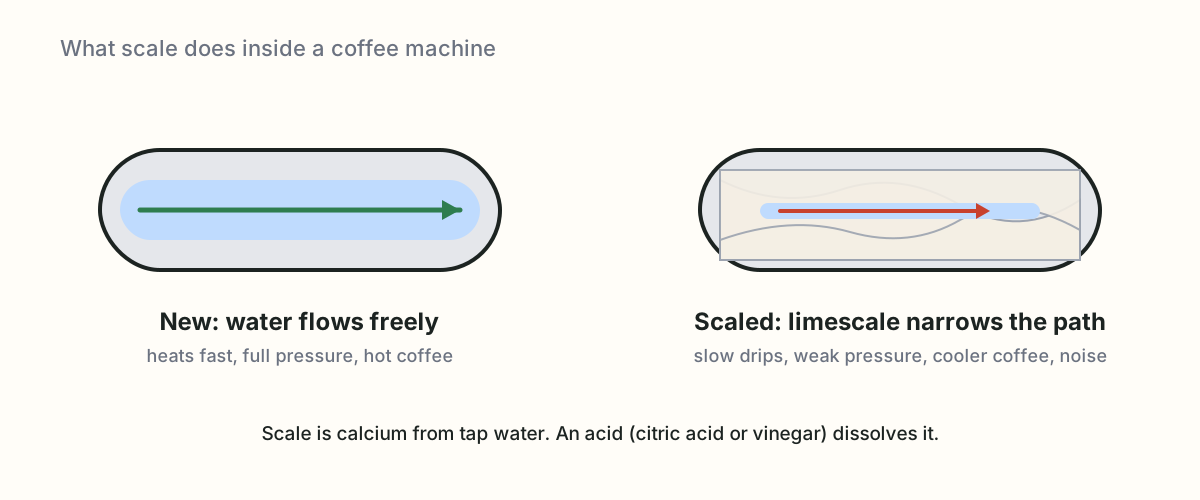
Short answer: Dissolve 1 to 2 tablespoons of citric acid in a liter of water (or use half white vinegar, half water for a drip or pod machine), run half of it through the machine, let it sit for 20 to 30 minutes, run the rest, then run two or three tanks of clean water to rinse. Do this every one to three months depending on how hard your water is.
Descaling is the maintenance job that keeps a cheap machine working like a new one. It takes 40 minutes, most of it waiting, and costs almost nothing.
What scale is, and why it matters
Tap water carries dissolved calcium and magnesium. Every time water is heated inside a coffee machine, a little of that mineral content is left behind as a hard white deposit called limescale. It builds up on the heating element and inside the narrow tubes.
Scale causes four problems, in roughly this order:
- Slower brewing. The water path narrows.
- Cooler coffee. Scale insulates the heating element, so the water does not reach full temperature. The coffee tastes flat and weak.
- Noise and sputtering. The pump works harder against the blockage.
- Failure. A heavily scaled element overheats and burns out, or a tube blocks completely. This is the most common reason a cheap machine dies young.
A scaled machine is not dirty in the usual sense. Scale is a mineral, and only an acid dissolves it, which is why soap and scrubbing do nothing.
How often
| Your water | Descale every |
|---|---|
| Hard (crust forms on taps and kettle within weeks) | 4 to 6 weeks |
| Medium | 2 to 3 months |
| Soft, or filtered through a pitcher | 3 to 6 months |
Signs you are overdue: the brew takes longer than it used to, the coffee is lukewarm, the machine is louder, or you can see white deposits in the water tank or on the heating plate.
What to descale with
Citric acid (recommended). Sold as a powder in the baking or canning aisle and online. Use 1 to 2 tablespoons per liter (about 15 to 30 g) of warm water. No smell, cheap, and safe for nearly every machine. Most branded descalers are largely citric acid.
White vinegar. Half vinegar, half water. Works well in drip and pod machines. The downsides: the smell lingers unless you rinse thoroughly, and several espresso machine makers advise against it because acetic acid can attack aluminum and rubber over time. Check your manual.
Branded descaler. Follow the bottle. More expensive but formulated for the machine, and the safe choice if your warranty depends on it.
Do not use: baking soda (it is a base, not an acid, and will not dissolve scale), bleach, or dish soap.
Descaling a drip coffee maker
- Empty the carafe and remove any used filter and grounds.
- Fill the water tank with the descaling solution (citric acid in water, or half vinegar and half water).
- Start a brew cycle. When about half the solution has run through, switch the machine off.
- Wait 20 to 30 minutes with the solution sitting in the machine.
- Switch it on and let the rest run through.
- Pour out the carafe, rinse it, and run two full tanks of clean water through. Three if you used vinegar and can still smell it.
- Wash the carafe and filter basket as usual.
Descaling a single-serve pod machine
- Remove any pod and empty the drip tray and the water tank. Take out the water filter if the tank has one.
- Fill the tank with descaling solution.
- Put a large mug under the spout and run brew cycles without a pod, emptying the mug each time, until the tank is empty. Some machines have a descale mode (hold a button combination); use it if the manual shows one.
- Let the machine sit for 30 minutes.
- Fill the tank with clean water and run it all through, a mug at a time. Repeat with a second tank.
- Put the filter back and run one more cycle before brewing coffee.
If the descale light stays on, the machine is waiting for its own reset sequence. The manual (or a quick search for your model and “reset descale”) will show it.
Descaling an espresso machine
Home espresso machines are the most sensitive to scale because their boilers run hotter and their tubes are narrower, and also the most sensitive to the wrong descaler. Use citric acid or the maker’s product unless the manual says vinegar is fine.
- Remove the portafilter and water filter. Empty the drip tray.
- Fill the tank with descaling solution.
- Run about a third of it through the group head (where the portafilter attaches) into a jug, and some through the steam wand, by opening the steam valve for 20 to 30 seconds.
- Switch off and wait 20 to 30 minutes.
- Run the rest through, group head and steam wand.
- Rinse with two full tanks of clean water, again through both the group head and the wand.
- Run a blank shot (no coffee) and discard the first real shot after that.
Some machines have an automatic descale program; follow it. For machines with a built-in grinder, keep the solution well away from the bean hopper.
Keeping scale down between descales
- Filter the water. A pitcher filter removes some of the hardness and roughly halves how often you need to descale. Filtered water also tastes better in coffee.
- Do not use distilled water on its own. Many machines need some minerals for their level sensors to work, and coffee brewed with pure distilled water tastes flat. A mix of half distilled, half tap is a common compromise in very hard water areas.
- Empty the tank if the machine will sit unused for more than a few days.
Descaling is not cleaning
Descaling removes minerals from the inside. It does not remove coffee oils, which build up on the brew basket, carafe, portafilter and group head and go rancid. Those need washing with hot water and dish soap, and for espresso machines a periodic backflush with a cleaning powder if the machine supports it. A machine that tastes bitter or stale after descaling usually needs this second kind of cleaning.
FAQ
How often should I descale my coffee maker?
Every one to three months, depending on your water. Hard water (white crust on your kettle or taps) means monthly. Soft or filtered water can go three months or longer. If the machine has a descale light, follow it.
Can I use vinegar to descale?
Yes, for drip and pod machines. Use half white vinegar, half water, and rinse with at least two full tanks of clean water afterward. Many espresso machine makers advise against vinegar, because it can corrode aluminum boilers and rubber seals; use citric acid or the maker’s own descaler for those.
Is descaler better than vinegar?
Citric acid is cheaper than branded descaler, has no smell, and is what many descaling products are made of. Vinegar works but leaves a smell that takes extra rinsing to remove. Branded descalers are convenient and safe for every machine; they just cost more.
My machine says descale but I just did. Why?
On most pod and espresso machines the light is on a counter, not a sensor, and it resets only when you run the machine’s own descale cycle (often a button combination). Check the manual for the reset.
Does descaling make coffee taste better?
Yes, noticeably, if the machine was scaled. Scale lowers the brewing temperature and slows the flow, which under-extracts the coffee and makes it taste flat. After descaling, the water runs hotter and faster and the coffee tastes like it did when the machine was new.
What is the white crust in my kettle?
The same thing: limescale, mostly calcium carbonate from hard water. The same citric acid or vinegar treatment removes it from a kettle in 15 minutes.