How-to · Coffee
How to Froth Milk at Home Without an Espresso Machine

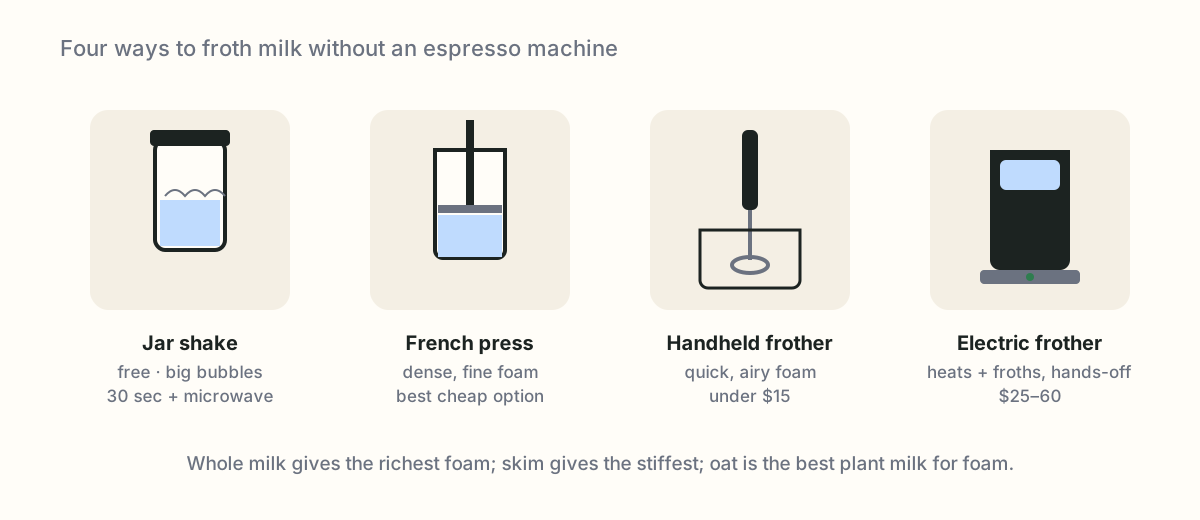
Short answer: The best cheap way to froth milk is a French press: pour in warm milk, pump the plunger up and down for 30 to 45 seconds, and you get thick, fine foam. A handheld frother (about the price of a sandwich) is faster and makes lighter foam. A jar with a lid works for free. An electric frother heats and froths by itself. Use whole milk warmed to about 140 to 150 °F (60 to 65 °C), and never let it boil.
You do not need an espresso machine to make a latte or cappuccino at home. Strong coffee from a moka pot, AeroPress or French press, plus properly frothed milk, gets close enough that most people cannot tell. Here are the four methods, from free upward.
First: the milk
Foam is made of milk protein wrapped around air bubbles. Fat makes it taste rich but makes the bubbles heavier; protein makes it stable.
| Milk | Foam | Notes |
|---|---|---|
| Whole dairy | Rich, creamy, stable | The best all-round choice |
| 2% dairy | Slightly lighter, still good | A fine everyday compromise |
| Skim dairy | Stiff, dry, lots of volume | Great volume, less flavor |
| Oat (barista blend) | Good, creamy | The best plant milk for foam |
| Soy | Decent | Can taste beany when hot |
| Almond, rice, coconut | Poor | Thin foam that collapses fast |
Start with cold milk straight from the fridge. Cold milk froths better and gives you more time before it overheats.
The temperature rule
Heat milk to 140 to 155 °F (60 to 68 °C). At that range it is sweet, the foam holds, and it is hot enough for a latte. Above about 160 °F (70 °C), the proteins start to break down: the foam collapses, and the milk tastes cooked. Boiled milk will not foam at all.
Without a thermometer: heat until the outside of the container is too hot to keep your hand on for more than a second or two. In the microwave, that is about 45 to 60 seconds for a cup (240 ml) on high; on the stove, medium heat with stirring until steam rises and tiny bubbles form at the edge, before it simmers.
Method 1: Shake it in a jar (free)
- Pour cold milk into a jar with a tight lid, no more than half full.
- Shake hard for 30 to 45 seconds until the volume has roughly doubled.
- Take the lid off and microwave for 30 to 45 seconds. The heat sets the foam.
- Let it sit for a few seconds, then spoon the foam onto your coffee and pour the milk after.
Result: big, loose bubbles. Fine for a cappuccino-style top, not for a silky latte. The fastest way to find out whether you want to make milk drinks at all before buying anything.
Method 2: French press (best cheap method)
- Warm the milk first, on the stove or in the microwave, to about 140 °F (60 °C). Fill the press no more than a third full; the milk will double or triple.
- Put the plunger in and pump it up and down quickly for 30 to 45 seconds, keeping the mesh just under the surface of the milk, where it pulls in air.
- For the last 10 seconds, pump with the mesh deeper in the milk. This breaks the big bubbles into small ones.
- Let it sit for 20 seconds, tap the press on the counter, swirl, and pour.
Result: dense, fine foam, the closest to a cafe texture of any method here. If you already own a French press, this is the one to use. Wash the press well afterward; milk residue in the mesh sours quickly. (If you also brew coffee in it, our French press guide covers taking the plunger apart for cleaning.)
Method 3: Handheld frother (fast, cheap)
A battery-powered wand with a small spinning whisk, usually sold for under $15.
- Warm the milk in a tall, narrow container (a mug or a small jug), filled no more than halfway.
- Put the whisk in, switch it on, and hold the head just below the surface. You should hear a light tearing sound as it pulls in air. 15 to 20 seconds.
- Lower the whisk into the middle of the milk for another 15 seconds to smooth the foam.
- Tap and swirl, then pour.
Result: airy, light foam, fast. The trick is the depth: too close to the surface and you get big bubbles; too deep and you get no foam. Tilting the container helps the milk swirl.
Method 4: Electric milk frother (hands-off)
A small jug with a heating element and a magnetic whisk, from about $25 to $60. Pour cold milk to the line, press one button, and it heats and froths in two to three minutes, then stops by itself.
Result: consistent, warm, medium-dense foam with no attention needed. Most have a cold setting and a “hot milk, no foam” setting too. The downside is counter space and one more thing to wash (the jug usually cannot go in the dishwasher). It is the right choice if you make milk drinks every day.
Fixing common foam problems
| Problem | Cause | Fix |
|---|---|---|
| Big, soapy bubbles | Air added too fast or too near the surface | Tap the jug on the counter, swirl; next time go deeper sooner |
| Foam collapses in a minute | Milk too hot, or low-protein milk | Start colder, stop under 155 °F, try whole or barista oat milk |
| No foam at all | Milk boiled, or whisk too deep | Fresh cold milk; keep the whisk just under the surface at first |
| Foam separates from milk | Left to sit too long | Swirl right before pouring |
| Tastes cooked or flat | Overheated | Use a thermometer once to learn what 150 °F feels like |
Putting it in the cup
- Latte: 1 part strong coffee to about 3 parts milk, with a thin layer of foam. Pour the milk from a few inches up so it mixes, then lower the jug at the end to lay the foam on top.
- Cappuccino: equal parts coffee, hot milk and foam. Hold the foam back with a spoon while pouring the milk, then spoon the foam on.
- Flat white: like a small latte with less foam. The French press method, with the extra 10 seconds of deep pumping, gets closest.
- Iced latte: cold milk, cold foam from a frother, coffee poured over ice.
The coffee underneath matters as much as the milk. Moka pot, AeroPress pressed hard, or a double-strength French press all stand up to milk; regular drip coffee gets lost in it.
FAQ
Which milk froths best?
Whole dairy milk gives the richest, most stable foam. Skim milk makes the stiffest, driest foam because it has more protein per volume and no fat to weigh it down. For plant milks, oat milk (especially ‘barista’ versions) froths best; almond and rice milk froth poorly.
What temperature should frothed milk be?
Between 140 and 155 °F (60 to 68 °C). Hot enough to feel too hot to hold the jug for more than a second or two, but not scalded. Above about 160 °F the proteins break down, the foam collapses and the milk tastes cooked.
Can I froth cold milk?
Yes. Cold foam for iced drinks is just milk frothed without heating. A handheld or electric frother does it well; the jar method works too. Cold foam is lighter and dissolves faster than hot foam.
Why is my foam full of big bubbles?
Too much air added too fast, usually from a handheld frother held near the surface for too long, or from shaking a jar. Fix it by tapping the jug on the counter a few times and swirling the milk; the big bubbles pop and the foam settles into a smoother texture.
Why does my foam disappear in a minute?
Either the milk was too hot, it was low-fat plant milk, or it was not frothed long enough to build structure. Use colder milk to start, keep the final temperature under 155 °F, and give the frother a little longer.
Is frothed milk the same as steamed milk?
Not quite. A steam wand heats and aerates at the same time and makes microfoam: tiny bubbles folded through the milk so it pours like wet paint. Home methods make foam that sits on top of the milk. It tastes the same in a latte, but it will not pour latte art.