How-to · Coffee
French Press vs Pour-Over: Which Should You Buy?

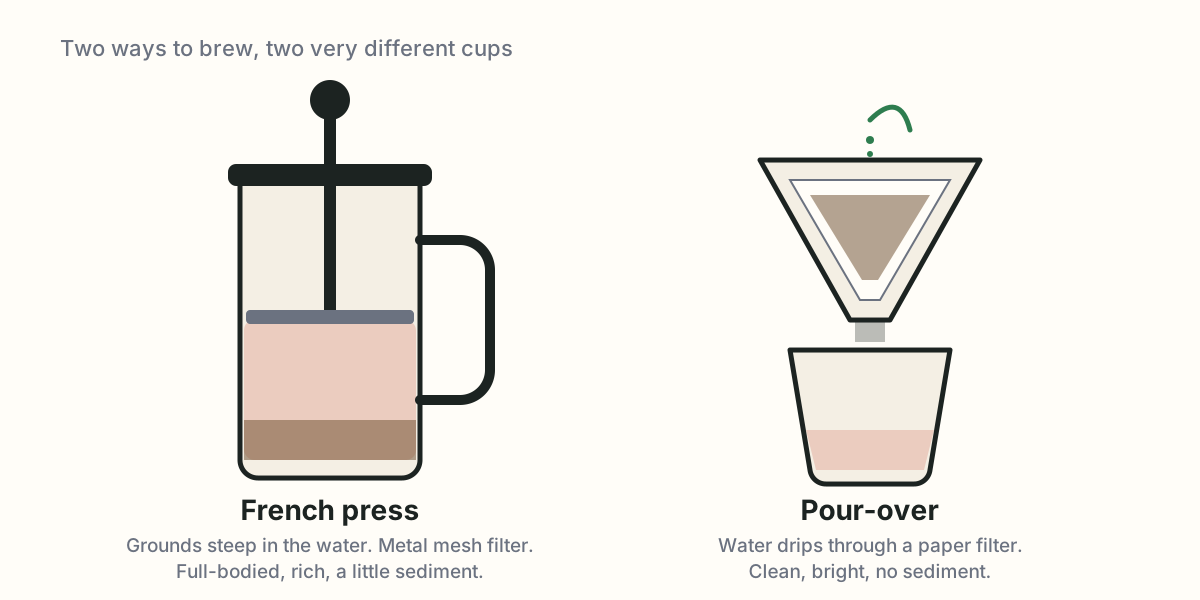
Short answer: Buy a French press if you want rich, full-bodied coffee with the least effort and no ongoing cost, or if you often make coffee for more than one person. Buy a pour-over if you like a clean, bright cup, enjoy the ritual, and mostly brew one mug at a time. If you cannot decide, the French press is the more forgiving first brewer.
Both cost about the same to buy, and both make better coffee than a cheap drip machine. The difference is in the cup and in the morning routine.
How each one works
A French press is a steeping brewer. Coarse grounds sit in hot water for about four minutes, then a metal mesh plunger pushes them to the bottom. Nothing is filtered out except the grounds themselves, so the coffee’s oils and the finest particles stay in the cup.
A pour-over is a drip brewer you control by hand. Medium-ground coffee sits in a paper filter in a cone, and you pour hot water over it in slow circles. The water passes through the coffee once, taking two to four minutes, and the paper filter holds back oils and sediment.
Everything that follows comes from that one difference: steeping with a metal filter, or passing through paper.
Taste
French press: heavy, round, full-bodied. Chocolate and nut flavors come forward; the cup feels thicker in the mouth because of the oils. There is always a little fine sediment at the bottom. People who like dark roasts and milk in their coffee usually prefer it.
Pour-over: lighter body, cleaner, more clarity. Acidity and fruit flavors are easier to pick out, which is why specialty cafes brew single-origin, lighter-roast beans this way. No sediment. People who drink coffee black, and who enjoy noticing the differences between beans, usually prefer it.
Neither is better. Think about the coffee you already enjoy: if your favorite cup is a bold dark roast, lean French press; if it is a bright, tea-like light roast, lean pour-over.
Effort and skill
French press is the easier brewer. Add coffee, add water, wait, press. The only skills are grinding coarse and not over-steeping, and you can walk away during the wait. See our French press guide for the full method.
Pour-over needs attention for the whole brew. The speed and pattern of your pour change the result, so the first week of cups can swing between weak and sour until you find a rhythm. It is a small skill, not a hard one, but you have to want to learn it. Some people find that part relaxing; others find it a chore before coffee.
Time
About the same, five to six minutes from kettle to cup. The difference is in the kind of time: with the French press most of it is waiting; with the pour-over most of it is pouring.
Cost
| French press | Pour-over | |
|---|---|---|
| Brewer | Roughly the same price range at the budget end | Roughly the same price range at the budget end |
| Ongoing cost | None | Paper filters, a few cents per cup |
| Useful extras | A grinder that grinds coarse evenly | A gooseneck kettle, a scale |
| Breakage | Glass carafes break; steel ones do not | Ceramic and glass cones can break; plastic ones do not |
Both are cheap to start. The pour-over has the longer upgrade path (kettle, scale, better cone), which is a cost or a hobby depending on how you look at it.
Cleanup
French press is the messier of the two. The grounds have to be scraped out of the carafe, the mesh plunger comes apart in three pieces for a proper wash, and the spent grounds clog a sink if you rinse them down.
Pour-over is the easiest cleanup in coffee: lift the paper filter out with the grounds inside, drop it in the compost, rinse the cone.
Making coffee for more than one person
The French press wins. A large press brews a liter at once with no extra effort. A pour-over for three or four cups means a bigger cone and three to four minutes of steady pouring, and the last cup is a little different from the first.
Which one to buy
Pick the French press if most of these are true:
- You like full-bodied or dark-roast coffee, or add milk.
- You want the simplest routine.
- You often make coffee for two or more.
- You do not want to buy filters.
Pick the pour-over if most of these are true:
- You drink coffee black and like tasting the differences between beans.
- You enjoy a small morning ritual.
- You mostly brew one cup at a time.
- You want the easiest cleanup.
If you want both
Many people end up with both, because they do different jobs: the French press for weekend mornings with company, the pour-over for a single careful cup. If you are buying one now and may add the other later, start with the French press. It is the one you will use on the days you are tired.
Grind size matters for both
Whichever you choose, the grind is the single biggest factor in whether the cup tastes right. French press wants coarse; pour-over wants medium. Our grind size chart covers every brew method, and if you are buying one accessory for either brewer, a grinder that produces an even grind improves the coffee more than any other upgrade.
FAQ
Which is healthier, French press or pour-over?
Pour-over, by a small margin. Paper filters trap most of the coffee oils (cafestol) that can raise cholesterol in people who drink a lot of unfiltered coffee. For a cup or two a day it is not a practical concern for most people; if your doctor has flagged cholesterol, pour-over or drip is the safer habit.
Which is cheaper to run?
The French press. It needs no filters, so after the one-time purchase the only cost is coffee. Pour-over uses a paper filter per brew; a box of 100 costs a few dollars, so it adds a few cents per cup.
Can I make more than one cup at a time?
Both can. A large (34 oz / 1 L) French press makes three to four mugs in one go, and it is easier, because the whole batch brews at once. Pour-over can make two to three cups in a larger cone, but you have to pour steadily for several minutes.
Which is better for a beginner?
The French press. There are fewer ways to go wrong: coarse grind, hot water, four minutes, press. Pour-over rewards practice; the first few cups can be sour or weak until you learn the pouring rhythm.
Do I need a gooseneck kettle for pour-over?
Not to start. A regular kettle poured slowly works. A gooseneck gives you a thin, controllable stream and makes consistent results much easier, so it is the first upgrade to make if you stick with pour-over.