How-to · Air Fryers
Air Fryer vs Convection Oven vs Toaster Oven: What's the Difference?

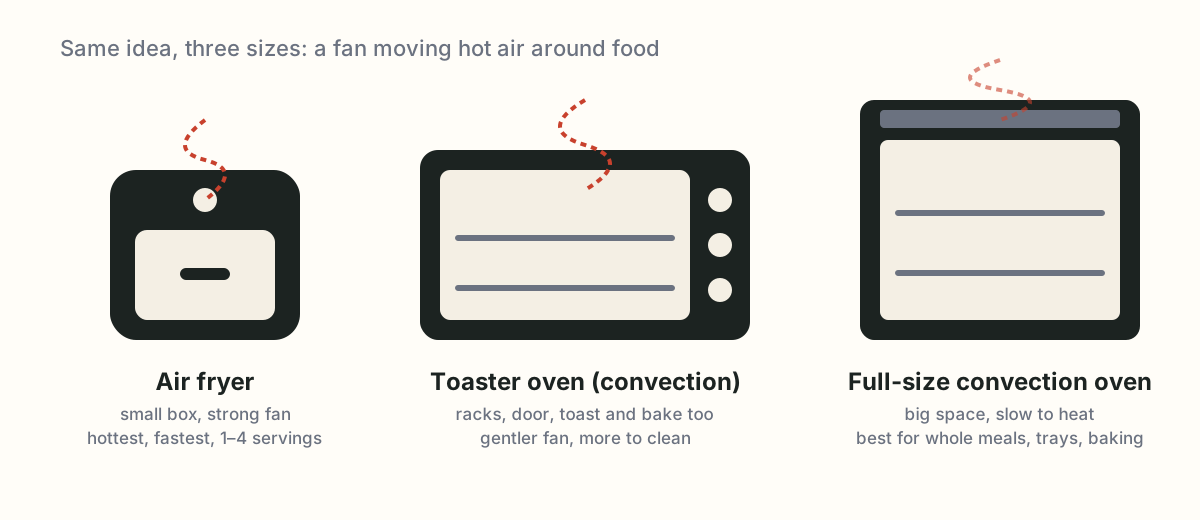
Short answer: They are the same technology at three sizes. A convection oven is a full-size oven with a fan. A toaster oven is a small countertop oven, often with a fan. An air fryer is a smaller box with a much stronger fan and a perforated basket, which is why it crisps fastest. For one to four people who want fries, wings, vegetables and reheated leftovers done quickly, an air fryer is the most useful of the three. For baking, trays of food and whole meals, the oven still wins.
They all do the same thing
Every oven cooks with hot air. A fan makes the hot air move, which strips the cool, damp layer that forms around food and lets heat in faster. That is “convection,” and it is why convection ovens cook about 25% faster and brown better than ordinary ones.
An air fryer takes the idea to its limit: a small chamber, a fan close to the food, and a basket with holes so air hits the food from all sides. Nothing is fried. The “fry” in the name is marketing for “very crisp.” The physics is the same as the convection oven in your kitchen, just concentrated.
The three compared
| Air fryer | Toaster oven (convection) | Full-size convection oven | |
|---|---|---|---|
| Heat-up time | 1 to 3 minutes | 3 to 6 minutes | 10 to 15 minutes |
| Crispness | Highest | Good | Good, slightly slower |
| Capacity | 1 to 4 servings | 2 to 4 servings, flat items | A full meal, trays, roasts |
| Can bake and toast | Limited (small cakes, no toast) | Yes | Yes |
| Counter space | Medium | Medium to large | None (built in) |
| Energy for a small portion | Lowest | Low | Highest |
| Cleanup | Basket and plate | Rack, tray, crumb tray, walls | Racks and trays |
| Price (budget end) | Lowest | Low to medium | Already in most kitchens |
Where the air fryer wins
- Speed for small portions. Frozen fries, a few chicken thighs, a tray of vegetables: in the basket, done in 12 to 20 minutes with no meaningful preheat.
- Crispness. Air from underneath through the basket holes means no soggy bottom. Reheated pizza and fried food come back closer to fresh than any other method.
- Energy and heat. It does not warm up the kitchen the way an oven does, and it uses a fraction of the energy for a single serving.
- Simplicity. Two settings, a shake halfway, done.
Where the air fryer loses
- Capacity. Anything that needs to spread out in a single layer, for more than three or four people, means two batches.
- Baking. The strong fan dries out and over-browns the top of cakes and breads before the middle is done. A small basket also will not take a standard pan.
- Anything flat and wide. Pizza, sheet-pan dinners, a tray of cookies.
- Noise. The fan is loud enough to notice from the next room.
Toaster oven with air fry mode: the middle ground
Many toaster ovens now have an “air fry” setting, which is the convection fan on its highest speed with a perforated basket on the rack. It is a real feature, not a sticker, but it is a compromise:
- Crisping is a step below a basket air fryer, because the fan is gentler and the food sits on a rack rather than in a basket with air coming up from below.
- It toasts, bakes, broils and reheats on a tray, which an air fryer cannot.
- It takes longer to heat and there is more to clean.
If you have room for only one countertop appliance and you make toast, this is the one. If you never toast and mostly want crisp, fast food, the basket air fryer does that job better and costs less.
Convection oven: when it is all you need
If you already have a convection oven, try this before buying anything: put food on a wire rack set in a rimmed baking sheet, use the convection roast or convection bake setting at 400 to 425 °F (200 to 220 °C), and turn the food once. For fries, wings and roasted vegetables, the result is close to an air fryer’s, a few minutes slower.
Where the oven never catches up is on convenience: the preheat, the heat in the kitchen, and the energy spent heating a large space to cook a small amount of food. If you cook mostly for one or two, that gap is what you are paying an air fryer to close.
Which one to buy
Buy an air fryer if you cook for one to four, want crisp food fast, reheat leftovers often, and already have an oven for big jobs. Our air fryer buying guide covers size and features.
Buy a toaster oven with air fry if counter space allows only one appliance, you make toast, and you bake small things.
Buy nothing if you have a convection oven, cook mostly full meals for a family, and do not mind the preheat. Use the rack-on-a-tray method above.
A note on “air fryer” ovens and multi-cookers
Large oven-style air fryers (a door and racks instead of a basket) behave like a small convection oven with a strong fan: more capacity, a little less crisp, more to clean. Multi-cookers with an air-fry lid add crisping to a pressure cooker; they are good at one-pot meals with a crisp finish, but the lid-based fan is usually the weakest crisper of the lot.
FAQ
Is an air fryer just a convection oven?
Essentially, yes. An air fryer is a compact convection oven with a faster fan and a basket that lets air reach the food from below. The small space and strong airflow are what make it crisp faster than a full-size oven.
Can a convection oven do everything an air fryer does?
Nearly. Set to convection roast at 400 to 425 °F on a wire rack over a tray, a convection oven crisps fries and chicken well; it takes a little longer and the result is slightly less crisp. The things it cannot match are the speed for small portions and the no-preheat convenience.
Is an air fryer cheaper to run than an oven?
For small portions, yes, by a wide margin. A full-size oven spends 10 to 15 minutes and a lot of energy heating a big empty space; an air fryer heats a small one in two or three minutes. For a full tray of food, the oven’s efficiency catches up.
Should I get a toaster oven with an air fry setting instead of an air fryer?
If counter space is tight and you also want to toast, bake and reheat on a tray, yes. Expect slightly less crisping than a basket air fryer, because the fan is gentler and the food sits on a rack rather than in a perforated basket with air coming from underneath.
Do I need to preheat an air fryer?
Usually not for frozen foods and vegetables; the box is small enough to be at temperature within a minute or two of starting. For meat where a quick sear matters, two to three minutes of preheat helps.