How-to · Gadgets
How to Choose a Kitchen Scale (and Why Every Kitchen Needs One)

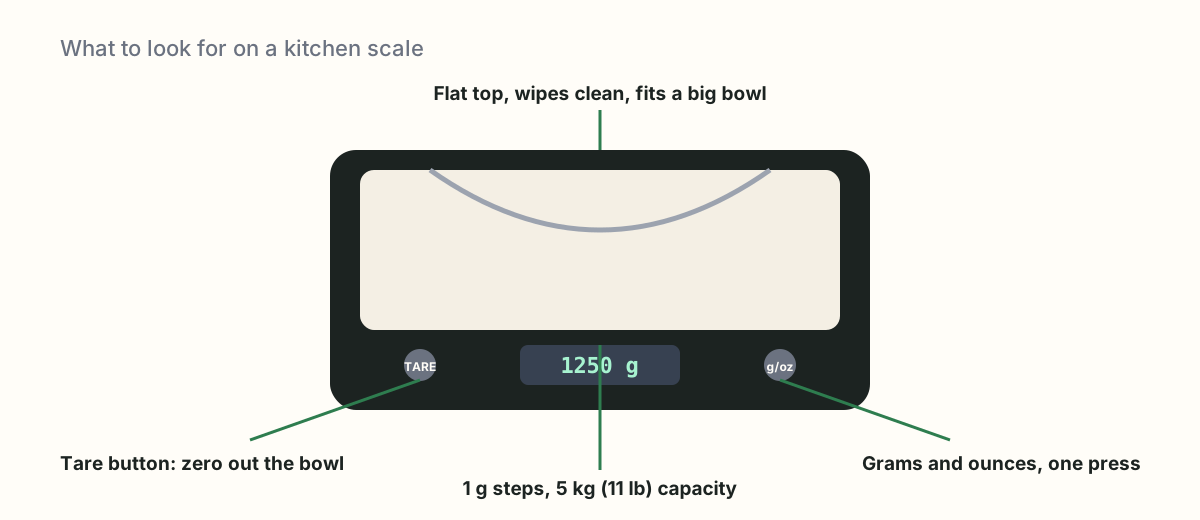
Short answer: Buy a digital scale that reads in 1 gram steps, holds at least 5 kg (11 lb), has a tare button, switches between grams and ounces, and has a flat platform big enough for your largest mixing bowl. Those five things make a good scale; the rest is convenience. Avoid scales that auto-off in under two minutes and any with a bowl built in.
Why weigh instead of measure
Cups measure volume. Flour, sugar and anything else that can be packed or fluffed gives a different weight every time it is scooped. One cup of flour can weigh 120 g lightly spooned or 160 g packed, a third more. A recipe that works for the person who wrote it then fails for you, and the reason is invisible.
A scale makes recipes repeatable, which is why nearly every serious baking recipe lists grams. It also:
- Replaces measuring cups and spoons for most jobs, so fewer things to wash.
- Lets you measure straight into the bowl, pressing tare between ingredients.
- Makes coffee consistent (a dose in grams, water in grams).
- Makes portions honest, if that matters to you.
The five things that matter
1. Increments: 1 g
Look for “1 g” or “0.1 oz” resolution. Scales that count in 2 g or 5 g steps are fine for meat and potatoes but not for baking powder, salt or yeast. For coffee and very small amounts, a separate 0.1 g pocket scale is a good second purchase; it is not a replacement, because those usually top out at 500 g or so.
2. Capacity: 5 kg (11 lb)
A big mixing bowl can weigh a kilogram before anything goes in it. 5 kg leaves room for the bowl and a large batch. Scales rated at 2 or 3 kg run out of room at the wrong moment.
3. Tare
The button that resets the display to zero with something already on the scale. It lets you put a bowl on, zero, add flour, zero, add sugar, and so on, all in one bowl. Every scale has one, but check that it is a real button and not a touch patch that fails with wet fingers.
4. Units
Grams and ounces at a minimum, switched with one press. Milliliters are sometimes offered; they are just grams with a different label (for water) and are not needed. Check that the unit setting is remembered between uses; some cheap scales reset to ounces every time.
5. Platform size and shape
A flat platform of at least 7 by 7 inches (18 by 18 cm) takes a mixing bowl without wobbling. The display should still be visible with a wide bowl on top, which is why scales with the display set forward, or a pull-out display, are easier to live with. Avoid scales with a built-in bowl: they are useless for anything that does not fit the bowl, which is most things.
The things that are nice to have
- Auto-off of 3 minutes or more, or none. Cheap scales switch off after a minute of no change, often mid-recipe. This is the most common complaint about kitchen scales.
- A flat, sealed surface that wipes clean. Buttons under a smooth membrane are easier to clean than raised buttons.
- Common batteries. AAA or a coin cell you can buy anywhere, or USB rechargeable. Avoid odd battery sizes.
- A backlit display. Helps on a dim counter.
- Low profile. Easier to store in a drawer.
- A hanging hook or a stand. Minor, but handy in a small kitchen.
Things you do not need to pay for
- Nutrition calculators built into the scale. Slow to use and the food database is never what you are weighing.
- App connectivity. A scale that needs a phone to show the weight is worse than one that does not.
- Glass platforms. They look nice and crack when dropped. Plastic or steel lasts.
- Very high capacity (15 kg and up). These are shipping scales; the increments are coarse.
Checking a scale’s accuracy
New or old, test it once:
- Put the scale on a hard, level surface (not a towel or a cloth).
- Weigh something of known mass. A US nickel is 5.00 g, so five nickels should read 25 g. A new sealed 1 kg bag of sugar should read within a few grams of 1000.
- Weigh the same thing in a different spot on the platform. The reading should not change.
- If it reads high or low by more than a gram or two, change the batteries first; low batteries cause drift. Then use the calibration mode if the scale has one (it will be in the manual).
A scale that passes these is accurate enough for anything in a home kitchen.
Using it well
- Weigh into the bowl, not into a cup then into the bowl.
- Press tare between every ingredient.
- Keep it on a hard, level surface; a tilted scale reads low.
- Do not leave heavy things sitting on it in the drawer; it stresses the sensor.
- Keep the platform dry; water under the platform is the most common way a scale dies.
For coffee, a scale with a timer built in is a small convenience for pour-over, where you time the pour and weigh the water at the same time. For everything else, the plain scale is better value. Our under-$25 gadgets list puts the scale at number one for a reason.
FAQ
Do I really need a kitchen scale?
If you bake, yes. A cup of flour can weigh anywhere from 120 to 160 grams depending on how it is scooped, which is the difference between a good loaf and a brick. For cooking, coffee and portion control it is a convenience rather than a necessity, but a strong one.
How accurate does a kitchen scale need to be?
1 gram increments are right for a general kitchen scale. For coffee, yeast, salt and baking powder, a 0.1 g pocket scale is better; many coffee drinkers own both. Scales that read in 2 or 5 g steps are fine for meat and vegetables but too coarse for baking.
What capacity should I get?
5 kg (11 lb) covers almost everything: a large mixing bowl plus a batch of dough, or a whole chicken. 10 kg scales exist but usually step in 2 g, which is worse for baking. Below 3 kg, you will hit the limit with a heavy bowl.
How do I check if my scale is accurate?
Weigh something of known mass. A US nickel weighs 5.00 g; five nickels should read 25 g. A sealed 500 g bag of flour or sugar should read close to 500 g. If the reading is off by more than a gram or two, use the scale’s calibration mode if it has one, or replace the batteries first, since low batteries cause drift.
Why does my scale turn off while I am using it?
Auto-off, usually at 1 or 2 minutes of no change. It is the most common complaint about cheap scales, especially for pour-over coffee or slow recipes. Look for a scale with auto-off of at least 3 minutes, or one that lets you turn it off.