How-to · Gadgets
12 Kitchen Gadgets Actually Worth Buying for Under $25

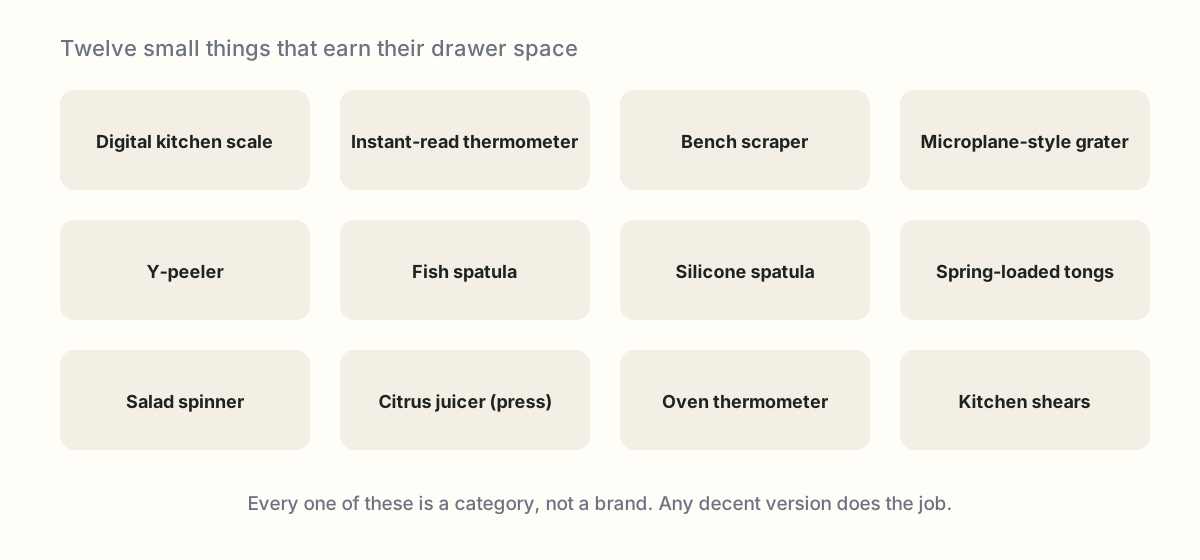
Short answer: The kitchen tools that are worth money are the ones you use every week and that do a job nothing else does well. For under $25 each, those are: a digital scale, an instant-read thermometer, a bench scraper, a microplane-style grater, a Y-peeler, a fish spatula, a silicone spatula, spring-loaded tongs, a salad spinner, a citrus press, an oven thermometer, and kitchen shears. Most single-purpose gadgets beyond that list are not.
These are categories, not products. We have not named brands here because for every one of these, a plain, well-made version from any established kitchenware maker does the job. (When we test specific models, the results go in our Under $25 picks.)
1. Digital kitchen scale
The single most useful cheap tool in a kitchen. Baking recipes work when flour is weighed instead of scooped; coffee is repeatable when the dose is in grams; portions are honest. A scale also replaces a set of measuring cups and the washing up that comes with them.
Look for: 1 g increments, at least 5 kg (11 lb) capacity, a tare button, a flat top that fits a large bowl, and a display you can still read with a big bowl on it. Our kitchen scale guide goes into detail.
2. Instant-read thermometer
Ends overcooked chicken and underdone pork. A thermometer tells you when meat is done in two seconds, which no amount of poking or timing does. It also checks oil for frying, water for coffee and bread dough, and whether the fridge is cold enough.
Look for: a reading in under 5 seconds, a thin probe (less of a hole in the meat), a folding probe for safe storage, and a backlit display. Waterproofing is worth a few dollars more.
3. Bench scraper
A flat rectangle of steel with a handle along one edge. It moves chopped vegetables from board to pan in one sweep, portions dough, scrapes the board clean, and cuts butter and brownies. Once you own one, you use it every time you cook.
Look for: a stiff steel blade, a handle that is comfortable to grip with the whole hand, and a ruler printed along the edge, which is handy for dough.
4. Microplane-style rasp grater
A long, fine grater with razor-sharp etched teeth. It turns parmesan into snow, zests citrus without the pith, grates garlic and ginger to paste, and shaves nutmeg. It replaces a garlic press and does a better job.
Look for: etched (not stamped) teeth, which stay sharp; a handle; and a cover for the drawer, because the teeth really are sharp.
5. Y-peeler
A peeler with the blade across the top, held like a razor. Faster and less tiring than a straight swivel peeler, and the wide blade handles squash, potatoes and carrots. Also makes vegetable ribbons and shaved cheese.
Look for: a carbon or stainless blade with some bite (test it on a carrot if you can), and a handle that does not get slippery wet. They cost very little; buy two, because they are easy to lose.
6. Fish spatula
Despite the name, the best all-round spatula. Thin, flexible, slotted steel with a beveled edge that slides under fried eggs, fish, burgers and cookies without tearing them. Replaces the thick plastic flipper that came free with your pans.
Look for: thin, springy stainless steel; a beveled front edge; a comfortable handle. Left-handed versions exist and are worth it if you are a leftie.
7. Silicone spatula
For scraping bowls, folding batter, stirring sauces and getting the last of the peanut butter out of the jar. Silicone is heat-safe, so one spatula does cold and hot jobs.
Look for: one-piece construction (no seam where the head meets the handle, which collects food and grows mold), heat rating of at least 450 °F (230 °C), and a slightly stiff head; very floppy ones are useless for stirring.
8. Spring-loaded tongs
A second pair of hands at the stove: turning meat, tossing pasta and salad, pulling pans out of the oven, fishing things out of boiling water. Twelve inches is the useful length.
Look for: stainless steel with a locking ring at the end, scalloped tips that grip, and silicone-tipped versions if you cook on non-stick. Avoid tongs with a stiff spring; they tire your hand.
9. Salad spinner
Dry salad leaves hold dressing; wet ones shed it and wilt. A spinner dries washed greens and herbs in half a minute, and the inner basket is a colander and the outer bowl a serving bowl. It earns its cupboard space if you eat salad weekly.
Look for: a pump or crank that locks or has a brake, a basket that sits stable in the bowl, and a lid that comes apart to wash. The small sizes are too small; get the one that holds a full head of lettuce.
10. Citrus press (hand juicer)
A hinged press that squeezes a halved lemon or lime in one motion, holding back the seeds. Faster and far less messy than a reamer or your hands, and it gets more juice out.
Look for: metal (plastic ones crack), a bowl large enough for a lemon (lime-sized ones are too small), and an enameled or stainless finish, since the acid pits bare aluminum.
11. Oven thermometer
Most home ovens run 10 to 50 degrees off what the dial says, which explains a lot of failed bakes. A cheap dial thermometer that hangs from a rack tells you the truth, and you adjust the dial to match.
Look for: a large, clear dial, a hook and a stand, and a range to at least 500 °F (260 °C). Check it against the oven once in each of the low, medium and high ranges, because ovens are often off by different amounts at different temperatures.
12. Kitchen shears
For cutting up a whole chicken, snipping herbs, opening packages, trimming fat and cutting pizza. The useful ones come apart at the pivot so both blades wash fully.
Look for: blades that separate for cleaning, a bone notch near the pivot, comfortable loops for the whole hand, and stainless steel. Avoid shears with built-in bottle openers and nutcrackers; they add nothing and make the handles uncomfortable.
What did not make the list
A garlic press (the grater does it better), an egg slicer, an avocado tool, a herb stripper, a banana slicer, a strawberry huller, a corn stripper, an apple corer, a pasta measure, most “multi-choppers,” and any tool with one job that a knife does in ten seconds. The test for a gadget is simple: if you can describe the job in one word, and that word is also a thing your knife does, you do not need it.
FAQ
What is the most useful cheap kitchen gadget?
A digital kitchen scale. It makes baking reliable, coffee repeatable, and portions honest, and it replaces a whole set of measuring cups. An instant-read thermometer is a close second because it stops you overcooking meat.
Which kitchen gadgets are a waste of money?
Single-purpose tools you use once a year: avocado slicers, strawberry hullers, banana slicers, garlic peelers, egg separators, herb strippers. A knife, a spoon or your hands do each of those jobs. Also most ‘as seen on TV’ choppers, which take longer to clean than they save.
Do I need a garlic press?
No. The side of a chef’s knife smashes a clove, and a microplane grater turns it to paste in seconds with far less to clean. A garlic press is fine if you already own one, but it would not make this list.
Is a salad spinner worth the space?
If you eat salad more than once a week, yes. Wet leaves make dressing slide off and go limp; a spinner dries them in 30 seconds, and the bowl doubles as a washing and serving bowl. If you rarely eat salad, a clean towel does the job.