How-to · Knives
How to Choose a Budget Chef's Knife: Steel, Handle and Weight

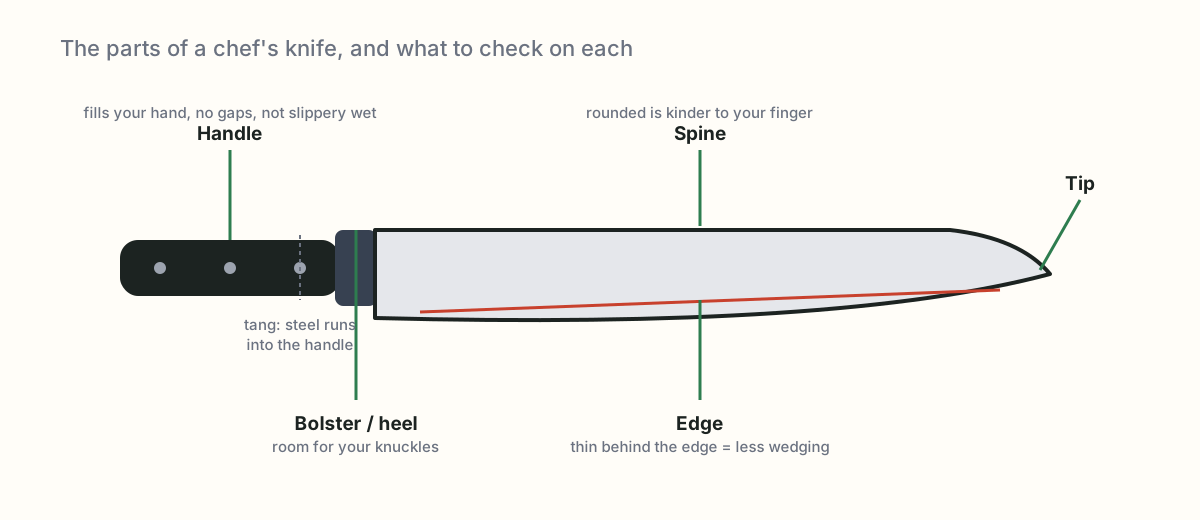
Short answer: For a budget chef’s knife, look for an 8-inch stainless blade that is thin behind the edge, a handle that fills your hand without pinching, and a weight that feels controllable rather than either feather-light or heavy. Skip knife sets, skip anything that claims it never needs sharpening, and spend the money you save on a whetstone. A cheap knife kept sharp beats an expensive knife kept dull every day of the week.
What actually makes a knife cut well
Three things, in order:
- Sharpness. Which is up to you, not the knife. Any decent steel can be made sharp.
- Thinness behind the edge. A thin blade glides through food; a thick one wedges and splits carrots instead of slicing them. This is the biggest difference between a good cheap knife and a bad one, and it is visible if you look at the blade edge-on.
- Fit in your hand. A knife you can hold comfortably for twenty minutes of prep is one you will use. A handle that pinches or a weight that tires your wrist is a knife that stays in the drawer.
Everything else (steel grade, forged or stamped, bolster or not) matters less than those three.
Steel
At the budget end you will see two kinds:
Stainless steel. Does not rust, tolerates neglect, and modern grades hold an edge well. This is the right choice for a first knife and for most kitchens. Marketing names vary; you cannot tell much from them at this price, so judge by feel and thinness rather than steel names.
Carbon steel. Takes a slightly keener edge, sharpens more easily, and develops a gray patina with use. It rusts if left wet. Good for people who like maintaining their tools; frustrating for everyone else.
Hardness is sometimes quoted as a Rockwell number (HRC). Around 55 to 58 is typical for Western knives: softer, tougher, easy to sharpen. Around 60 and up is typical for Japanese knives: harder, holds an edge longer, chips more easily. Both are fine; it changes how you sharpen, not whether the knife is good.
Blade shape and thickness
- Length: 8 inches (20 cm) for most people. 6 inches for small hands or small boards. (If you are unsure between this and a santoku, our chef’s knife vs santoku guide covers the difference.)
- Thickness at the spine: budget knives range from very thin (under 2 mm) to thick (3 mm or more). Thinner is lighter and cuts with less effort; thicker is tougher for heavy work. For general cooking, lean thin.
- Behind the edge: look at the blade edge-on. The steel should taper to the edge gradually, not drop off a thick shoulder. This is the wedging test.
- Curve: a gentle curve for rocking. A very flat edge suits chopping; a very curved one is for specialty work.
Handle
This is personal, so handle the knife if you can, and if buying online, read the dimensions.
- Fills your hand. Your fingers should wrap it without the tips digging into your palm, and without a lot of space left over.
- No hot spots. Hard edges, seams, or a square spine that digs into your index finger will hurt after ten minutes. A rounded spine is a small luxury worth having.
- Grippy when wet. Smooth polished plastic gets slippery. Textured plastic, rubberized, or wood with some grain are better.
- Knuckle clearance. With the knife on the board, your knuckles should not hit the board. The blade needs enough height at the heel, usually about 1.75 inches (45 mm) or more for an 8-inch knife.
- Solid. Nothing should flex, rattle, or show a gap between handle and blade. A gap collects water and food.
Weight and balance
Hold the knife in a pinch grip (thumb and index finger on the blade just in front of the handle). It should feel balanced around that point, or slightly blade-heavy. A knife that tips hard toward the handle feels dead; one that tips hard toward the tip tires your wrist.
Light knives (under about 6 oz / 170 g) are nimble and good for long prep. Heavier ones (8 oz / 225 g and up) carry momentum through hard vegetables. Neither is right; pick the one that feels like an extension of your hand.
Forged vs stamped
Forged knives are shaped from a single bar of heated steel, usually thicker, heavier, with a bolster (the thick collar between blade and handle). Stamped knives are cut from a flat sheet, thinner and lighter, no bolster.
The old rule that forged is always better is not true. Many of the best-regarded budget knives are stamped, and thinness is an advantage. What to avoid is a full bolster that runs down to the edge: it stops you sharpening the last inch of the blade, and after a year of sharpening the edge develops a step at the heel. A half bolster, or none, is better.
Things not worth paying for
- Knife sets. A block of eight knives for the price of two good ones. You will use the chef’s knife, the paring knife and the bread knife; the rest are padding. Buy those three separately.
- “Never needs sharpening.” This means a serrated or coated edge that cannot be sharpened when it does wear, which it will.
- Damascus patterns on cheap knives. Usually printed or etched on the surface, with no effect on cutting.
- Brand names on the blade. At this price, the name is the most expensive thing about the knife.
- Hollow handles. Light, but often badly balanced and sometimes leak.
Things worth paying a little more for
- A thinner grind. The single biggest upgrade in cutting feel.
- A rounded spine and a comfortable handle. You feel these every day.
- A knife that comes sharp out of the box. It tells you the maker finished the edge properly.
Before you buy: the in-store checks
- Pinch grip. Does it balance near the blade?
- Look edge-on. Does it taper thin behind the edge?
- Close your fingers. Any pinching or hard edges?
- Press the blade tip gently on the counter. Does it flex a lot? (A little is fine; a lot means thin, soft steel.)
- Check the bolster. Can you reach the heel of the edge with a stone?
After you buy
The knife you buy matters less than keeping it sharp. A honing rod used weekly and a whetstone every few months keep a budget knife cutting like a far more expensive one. Wash by hand, dry straight away, and cut on wood or plastic, never glass or stone.
FAQ
Is a cheap chef's knife worth buying?
Yes. A good budget chef’s knife, kept sharp, outperforms an expensive one left dull. The things you give up at the low end are edge retention (you sharpen more often), fit and finish, and sometimes balance. None of those stop it from cutting well.
Stainless or carbon steel for a first knife?
Stainless. It does not rust, needs no special care, and modern stainless holds a fine edge. Carbon steel gets a little sharper and is easier to sharpen but rusts if left wet and discolors with use; it suits people who enjoy looking after tools.
Does a full tang matter?
Less than knife marketing suggests. A full tang (steel running the full length of the handle) adds strength and balance, and is a sign of a better-made knife, but plenty of good light knives have partial tangs. Check that the handle feels solid and nothing flexes or rattles.
Forged or stamped?
At budget prices, stamped. Stamped blades are cut from a sheet of steel, are thinner and lighter, and cost less; many excellent knives are stamped. Forged knives are thicker and heavier with a bolster. Neither process makes a knife sharper; the steel and the grind do.
What should I avoid?
Knife sets (you pay for pieces you will not use), knives with a thick bolster that runs to the edge (it stops you sharpening the heel), ‘never needs sharpening’ claims (that means serrated or coated edges that cannot be fixed), and anything so light and thin it flexes.