How-to · Knives
How to Use a Honing Rod (and Why It Isn't Sharpening)

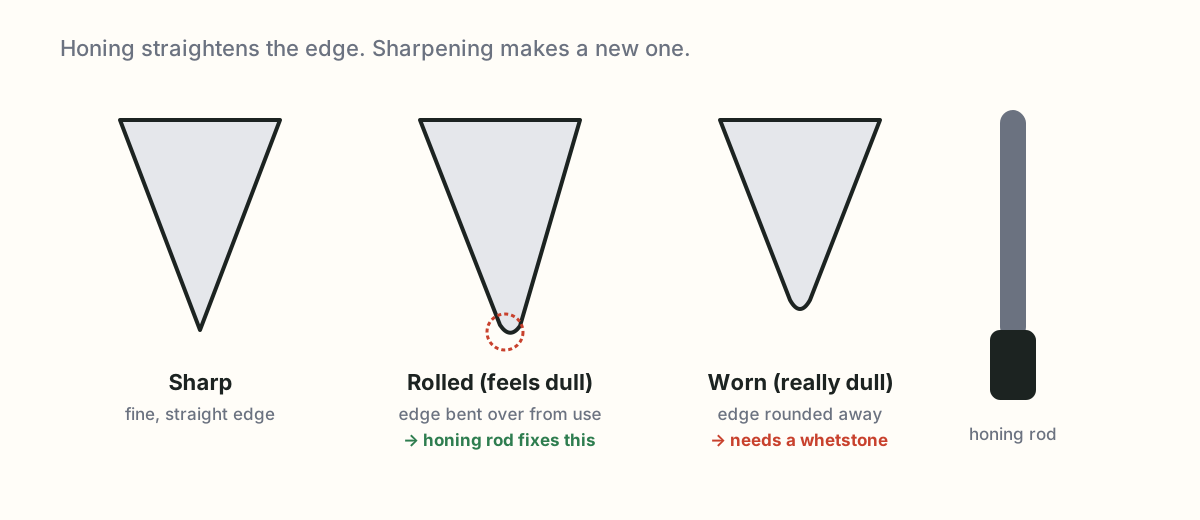
Short answer: A honing rod does not sharpen; it straightens. The thin edge of a knife bends over slightly with use, and a few light strokes on the rod push it back in line, so the knife cuts like it did a week ago. Hold the rod point-down on a towel, hold the knife at about 15 to 20 degrees, and draw it down the rod from heel to tip, four or five strokes per side, light pressure. Do it once a week. When honing stops helping, the edge is worn and needs a whetstone.
Honing vs sharpening
A sharp edge is a very thin line of steel. In use, that line bends a tiny amount to one side; the knife is still sharp, but the edge is no longer pointing straight down, so it slides across food instead of biting. That is a rolled edge, and it is why a knife seems to go dull faster than the steel could possibly wear.
Honing pushes the rolled edge back to center. It removes essentially no metal. It is fast and you should do it often.
Sharpening grinds away metal to form a new edge, when the old one has actually worn round. It takes longer, removes steel, and you should do it only every few months. Our whetstone guide covers it.
A knife that is honed regularly needs sharpening far less often. A knife that is never honed goes “dull” within days of sharpening, when in fact its edge is just bent.
Which rod
| Rod | What it does | Best for |
|---|---|---|
| Steel (grooved) | Realigns only | Western chef’s knives with softer steel; the classic |
| Steel (smooth) | Realigns, gentler | Any knife; kinder to hard steel |
| Ceramic | Realigns and removes a trace of metal | Japanese and harder-steel knives; a slight sharpening effect |
| Diamond | Removes metal, fairly aggressively | Quick touch-ups on very dull knives; easy to overdo |
For a kitchen with ordinary Western knives, a grooved or smooth steel rod is fine. If you own Japanese knives, buy a ceramic rod and use light strokes. A diamond rod is closer to a coarse sharpener than a hone; use it sparingly or not at all on good knives.
Buy a rod at least as long as your longest blade. A 10- or 12-inch (25 to 30 cm) rod suits an 8-inch chef’s knife.
How to hone: the safe way
The method where the rod is held in the air and the knife swept toward your hand looks professional and is how people cut themselves. Do this instead.
- Stand the rod on its tip on a folded towel on the counter, handle up, held firmly in your non-knife hand. The towel stops it slipping.
- Hold the knife at the angle it was sharpened at. About 20 degrees for a Western chef’s knife, about 15 for a Japanese knife. Twenty degrees is roughly the angle of a matchbook held against the rod; if you do not know your knife’s angle, 15 to 20 is close enough.
- Place the heel of the blade against the top of the rod, edge touching, at that angle.
- Draw the knife down and toward you, sweeping from heel to tip so the whole edge touches the rod on the way down. Light pressure, as if you were trying to shave a thin layer off the rod. The stroke takes about a second.
- Switch to the other side of the rod and repeat with the other side of the blade.
- Four or five strokes per side, alternating. Then wipe the blade; honing leaves a trace of steel dust.
That is the whole thing. Ten seconds.
Common mistakes
- Pressing hard. The rod is harder than the knife. Pressure rolls the edge the other way, or chips it. Light.
- Fast, dramatic strokes. Speed does nothing; it only makes the angle wobble. Slow and even.
- Too steep an angle. Holding the knife at 30 or 40 degrees thickens the very edge over time and the knife gets duller with every hone. Stay at or just above the sharpening angle.
- Too many strokes. Five per side is plenty. Twenty is not better.
- Honing a chipped or badly worn knife. A rod cannot fix it. If five strokes per side does not bring the edge back, stop and sharpen.
- Honing Japanese knives on a grooved steel. Hard steel chips against the grooves. Use ceramic, or skip the rod and use a fine stone.
How to tell whether a knife needs honing or sharpening
Hone first. If the knife slices paper or a tomato skin cleanly afterward, you are done. If it still catches or slides, the edge is worn and honing will not help: it needs the stone.
A good rhythm for a daily-use knife is a hone every few days and a stone every two or three months. With that, even a cheap knife stays sharp enough that you never think about it.
Caring for the rod
Wipe steel and ceramic rods with a damp cloth now and then; a little dish soap if there is steel dust in the grooves. Ceramic rods are brittle; do not drop them. Diamond rods wear out after a few years; steel and ceramic last indefinitely.
FAQ
Does a honing rod sharpen a knife?
A plain steel rod does not. It realigns an edge that has bent slightly to one side during use, which makes the knife feel sharp again. It removes almost no metal. Ceramic and diamond rods do remove a little metal, so they sharpen very slightly, but neither replaces a whetstone.
How often should I hone?
Every few uses for a knife you use daily; once a week is plenty for most home cooks. It takes ten seconds. Sharpen on a stone every two or three months, or when honing no longer brings the edge back.
What angle do I hold the knife at on a honing rod?
The same angle the knife was sharpened at: about 20 degrees for a Western chef’s knife and about 15 for a Japanese one. Slightly steeper than the knife’s bevel is fine; much steeper rounds the edge over time.
Should I hone a Japanese knife?
Gently, and preferably on a ceramic rod. Japanese knives use harder steel that chips rather than rolls, and a grooved steel rod can take small chips out of it. A smooth ceramic rod or a few light strokes on a fine whetstone is the safer habit.
Can I hone a serrated knife?
The flat back side can be honed with a few light strokes, which helps a little. The serrations themselves cannot be honed on a rod. A serrated knife that has gone dull needs a tapered sharpening rod that fits the scallops.