How-to · Knives
Chef's Knife vs Santoku: Which One Should You Buy First?

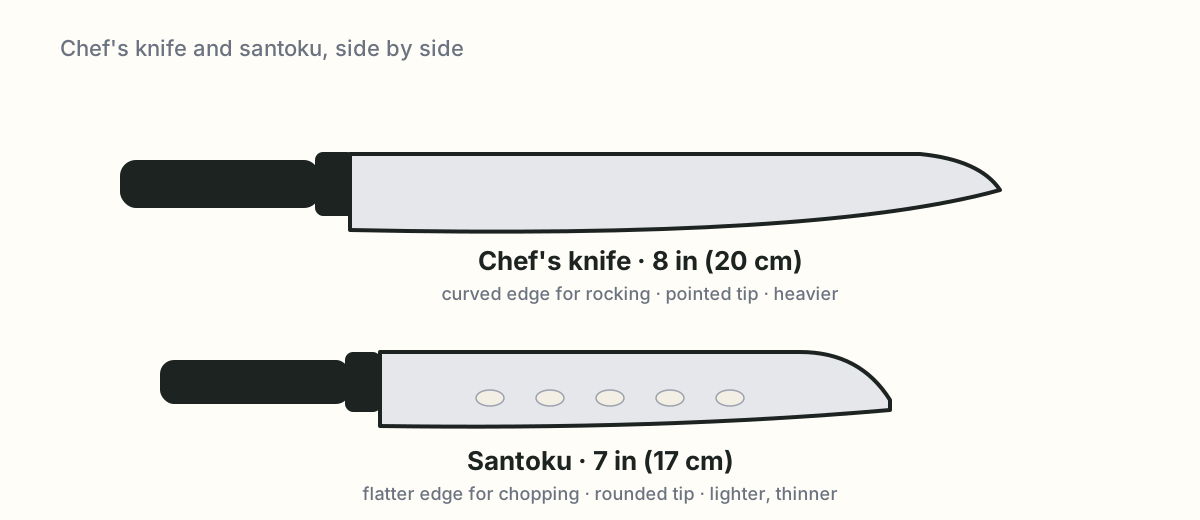
Short answer: If you are buying one good knife, get an 8-inch chef’s knife. It does everything, and its curved edge handles the widest range of cuts. Get a santoku instead if you have smaller hands or a small cutting board, you chop straight up and down rather than rocking, or you mostly cut vegetables and boneless meat. Both are “the one knife”; they just feel different in the hand.
The two shapes
A chef’s knife (Western style, also called a cook’s knife) has a blade that curves up to a pointed tip. The curve is the point of it: you keep the tip on the board and rock the blade through food. Standard length is 8 inches (20 cm); 6 and 10 exist.
A santoku is the Japanese home-kitchen equivalent. The edge is flatter, the tip is rounded (a “sheepsfoot” profile), and the blade is a little shorter, usually 7 inches (17 to 18 cm), thinner and lighter. Many have scalloped dimples along the side. The flat edge suits a straight chopping motion, lifting the whole blade each stroke.
Both are general-purpose. The chef’s knife rocks; the santoku chops. Everything else follows from that.
Side by side
| Chef’s knife | Santoku | |
|---|---|---|
| Length | 8 in (20 cm) typical | 7 in (17–18 cm) typical |
| Edge | Curved | Nearly flat |
| Tip | Pointed | Rounded |
| Weight | Heavier | Lighter |
| Blade | Thicker | Thinner |
| Cutting motion | Rocking | Up and down, push cuts |
| Best at | Big vegetables, herbs, meat with bone, carving | Thin slices, precise dicing, boneless meat, fish |
| Sharpening angle | About 20° per side | About 15° per side |
| Fits | Larger hands, larger boards | Smaller hands, smaller boards |
Where the chef’s knife is better
- Rocking cuts. Mincing herbs and garlic by rocking the tip-down blade is fast and effortless with a curved edge, awkward with a flat one.
- Large, hard vegetables. The length and weight get through squash, cabbage and melons with less effort.
- Meat with bones. The pointed tip gets into joints; the thicker blade tolerates contact with bone.
- Big boards and big batches. More length means fewer strokes.
Where the santoku is better
- Thin, even slices. The thinner blade and flat edge glide through onions, cucumbers and tomatoes with less wedging.
- Small hands and small boards. Shorter and lighter; easier to control for long sessions.
- Precise dicing. The flat edge makes a clean, full-length cut with each stroke, so dice come out even.
- Boneless proteins and fish. The thin blade suits clean slicing.
The santoku’s limits: the rounded tip is poor at piercing and at getting into joints, and the thin blade should stay away from bones, frozen food and hard squash.
How do you actually cut?
This decides it for most people. Watch yourself chop an onion:
- If you keep the tip on the board and rock the handle up and down, you want a chef’s knife.
- If you lift the whole blade and bring it straight down, you want a santoku.
People who learned from Western cooking shows tend to rock; people who learned from Japanese or Chinese cooking tend to chop. Neither is wrong. Buying the knife that matches your motion is the difference between a knife you reach for and one that stays in the block.
Hand size and board size
An 8-inch chef’s knife on a small apartment cutting board feels cramped, and that is a daily annoyance. A 7-inch santoku on a 12-inch board feels right. If your board is under about 14 inches (35 cm), or your hands are on the smaller side, lean santoku or a 6-inch chef’s knife.
Price and quality
At the budget end, chef’s knives and santokus from the same maker cost the same and use the same steel. The things that matter more than shape are a blade that holds an edge, a handle that fits your hand, and a weight you like. Our budget chef’s knife guide covers steel, handles and what to check in the store.
Keep it sharp either way
Whichever you buy, a cheap knife kept sharp cuts better than an expensive one left dull. A honing rod every week or two and a whetstone every few months is all it takes. Santokus and most Japanese-style knives want a slightly lower angle on the stone, about 15 degrees per side, compared with about 20 for a Western chef’s knife.
The decision
- Default: 8-inch chef’s knife.
- Small hands, small board, or you chop straight down: santoku.
- You already own one: the other is a good second knife, because they fill each other’s gaps.
FAQ
What is a santoku knife used for?
Everything a chef’s knife does: vegetables, meat, fish. The name means ‘three virtues’ in Japanese, for slicing, dicing and mincing. Its flatter edge suits straight up-and-down chopping and thin slicing, and it is a little less suited to rocking cuts and to carving around bones.
Is a santoku better than a chef's knife?
Neither is better. The santoku is lighter, shorter and flatter, which many people with smaller hands or small cutting boards prefer. The chef’s knife is longer and curved, which suits rocking cuts, big vegetables and heavier work. Pick by how you cut and what you cut.
What size chef's knife should I buy?
8 inches (20 cm) is the standard and the right first choice for most people. Go to 6 inches if you have small hands or a small board; go to 10 inches only if you regularly break down large vegetables or big cuts of meat.
Do the dimples on a santoku work?
A little. The scallops (a ‘granton edge’) create air pockets that help slices of potato or cucumber fall away instead of sticking. The effect is real but small, and a thin blade matters more than the dimples. They are not a reason to choose one knife over another.
Can a santoku be sharpened like a chef's knife?
Yes, on the same whetstone. Many santokus are ground to a slightly lower angle (around 15 degrees per side) than Western chef’s knives (around 20), so hold the knife a touch flatter. See our whetstone guide for the method.