How-to · Gadgets
How to Use a Meat Thermometer (and the Temperatures to Cook To)

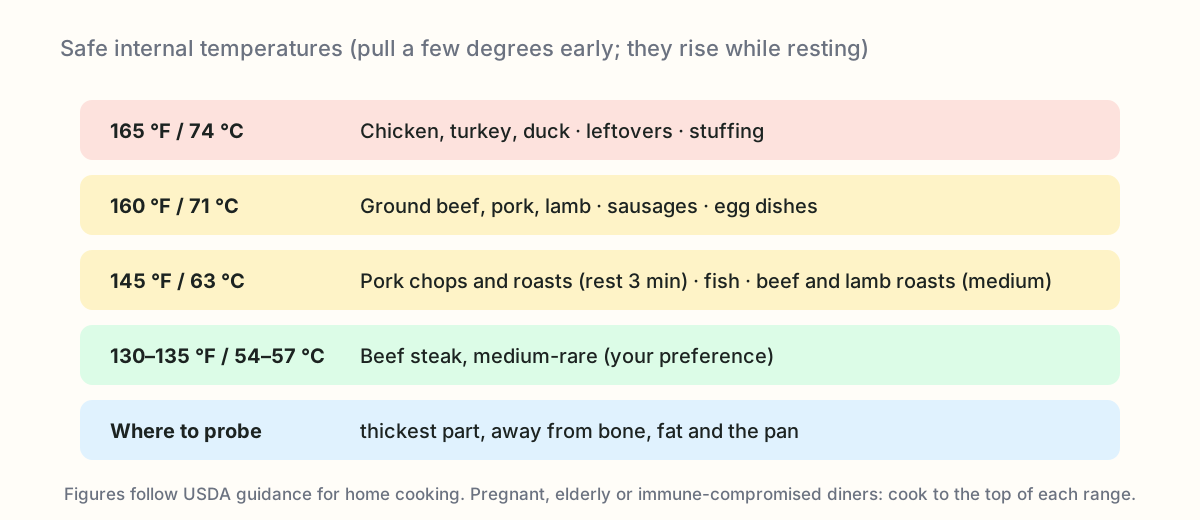
Short answer: Push the probe into the thickest part of the meat, away from bone, fat and the pan, and read it. Chicken is done at 165 °F (74 °C), ground meat at 160 °F (71 °C), pork and fish at 145 °F (63 °C), and steak at whatever you like, around 130 to 135 °F for medium-rare. Pull the meat 3 to 10 degrees before the target, because it keeps cooking while it rests. Check the thermometer in ice water once a year.
A thermometer is the cheapest thing that makes you a better cook. It replaces guessing, poking, cutting into the meat to look, and the oven timer, all of which are wrong often enough to ruin dinner.
Which thermometer
Instant-read (probe on a handle). For quick checks: push it in, read in a few seconds, take it out. This is the one to buy first. Look for a thin probe, a reading in under 5 seconds, and a folding design. Our gadgets under $25 list has what to look for.
Leave-in probe. A probe on a heat-proof cable that stays in the meat while a display outside the oven shows the temperature, usually with an alarm. Good for roasts and anything that takes a long time. Some are wireless.
Dial (analog) thermometer. Slow, less precise, and the dial is hard to read. Fine as a backup; not the one to rely on.
Oven thermometer. A different tool: it measures the oven’s air, not the meat, and tells you whether the oven runs hot or cold.
Where to probe
The probe measures only the point at its tip. Put the tip in the center of the thickest part, and keep it away from:
- Bone, which heats faster than meat and reads high.
- Fat pockets, which read low.
- The pan or grill, which reads very high.
- Stuffing in a bird, which is cooler than the meat; check the stuffing separately (it also needs 165 °F).
For a thin piece (a chop, a chicken breast, a burger), go in from the side, parallel to the board, so the tip sits in the middle rather than poking through.
For a whole chicken or turkey, probe the thickest part of the thigh, then check the breast too. The thigh is the last part to finish.
When to check
Check early rather than late. For a steak or chop, start checking a couple of minutes before you think it will be done. For a roast, start at about two-thirds of the expected time. A thermometer hole lets out a negligible amount of juice; the myth that it “drains the meat” is not worth worrying about.
Each check takes a few seconds. Push it in, wait for the number to stop climbing, read, pull it out.
Safe internal temperatures
| Meat | Done at | Pull from heat at | Notes |
|---|---|---|---|
| Chicken and turkey, all cuts | 165 °F / 74 °C | 160 °F | Thigh for whole birds |
| Ground beef, pork, lamb | 160 °F / 71 °C | 155 °F | Burgers, meatloaf, sausages |
| Ground chicken or turkey | 165 °F / 74 °C | 160 °F | |
| Pork chops, roasts, tenderloin | 145 °F / 63 °C, rest 3 min | 140 °F | Pink center is fine |
| Beef or lamb roast, medium-rare | 135 °F / 57 °C | 125 °F | Big roasts carry over the most |
| Beef or lamb roast, medium | 145 °F / 63 °C | 135 °F | |
| Steak, medium-rare | 130 to 135 °F / 54 to 57 °C | 125 °F | Preference, not safety |
| Steak, medium | 140 °F / 60 °C | 135 °F | |
| Fish | 145 °F / 63 °C | 140 °F | Or until it flakes; salmon is often cooked to 125 °F for a softer texture |
| Shrimp, lobster, crab | Opaque and firm | — | About 120 °F |
| Leftovers, casseroles | 165 °F / 74 °C | — | |
| Egg dishes | 160 °F / 71 °C | — |
These follow USDA guidance. People who are pregnant, elderly, or immune-compromised should cook to the done temperature rather than pulling early.
Carryover cooking
Meat does not stop cooking when it leaves the heat. The outside is much hotter than the center, and that heat keeps moving inward for several minutes. The center temperature rises:
- Thin cuts (chops, chicken breast, burgers): 3 to 5 °F.
- Thick steaks: 5 °F.
- Roasts and whole birds: 5 to 10 °F, sometimes more.
So pull the meat below the target and let it rest. Resting also lets the juices settle so they stay in the meat when you cut it. Five minutes for a chop, 10 to 15 for a roast.
Checking the thermometer
Once a year, or whenever a reading seems off:
- Ice water test. Fill a glass with ice, add cold water, stir, wait a minute. Put the probe in the middle without touching the sides. It should read 32 °F (0 °C), within a degree or two.
- Boiling water test. Should read 212 °F (100 °C) at sea level. At altitude, water boils lower (about 203 °F at 5,000 ft / 1,500 m).
If it is off, use the calibration button or nut if there is one; otherwise note the offset and adjust, or replace it. Change the battery first; a weak battery is the most common reason for drift.
Care
Wipe the probe with hot soapy water after each use (do not submerge the display unless it is rated waterproof). Store it folded or in its sheath. Do not leave an instant-read thermometer in the oven; the display is not built for it.
FAQ
Where do I put the thermometer in chicken?
In the thickest part of the thigh for a whole bird, not touching bone, or the thickest part of a breast or thigh piece. 165 °F (74 °C). Check two spots on a whole chicken; the thigh is always the last to come up.
Can I leave the thermometer in while cooking?
Only a leave-in probe thermometer, which has a heat-safe cable to a display outside the oven. An instant-read thermometer is for quick checks and should not stay in the oven; its display and battery are not built for that heat.
What is carryover cooking?
Meat keeps cooking after it leaves the heat, because the hot outside keeps passing heat to the center. A roast can rise 5 to 10 °F while resting; a thin chop 3 to 5 °F. Pull meat from the heat that many degrees below your target.
How do I check my thermometer is accurate?
Ice water: fill a glass with ice, top with water, stir, wait a minute, and insert the probe without touching the glass. It should read 32 °F (0 °C). Boiling water should read 212 °F (100 °C) at sea level, less at altitude. Many thermometers have a calibration nut or button if they are off.
Is it safe to eat pork at 145 °F?
Yes. The USDA lowered the recommendation for whole cuts of pork to 145 °F (63 °C) with a three-minute rest in 2011. It will be slightly pink in the middle. Ground pork is still 160 °F.