How-to · Gadgets
How to Choose a Budget Blender: Personal, Full-Size or Immersion

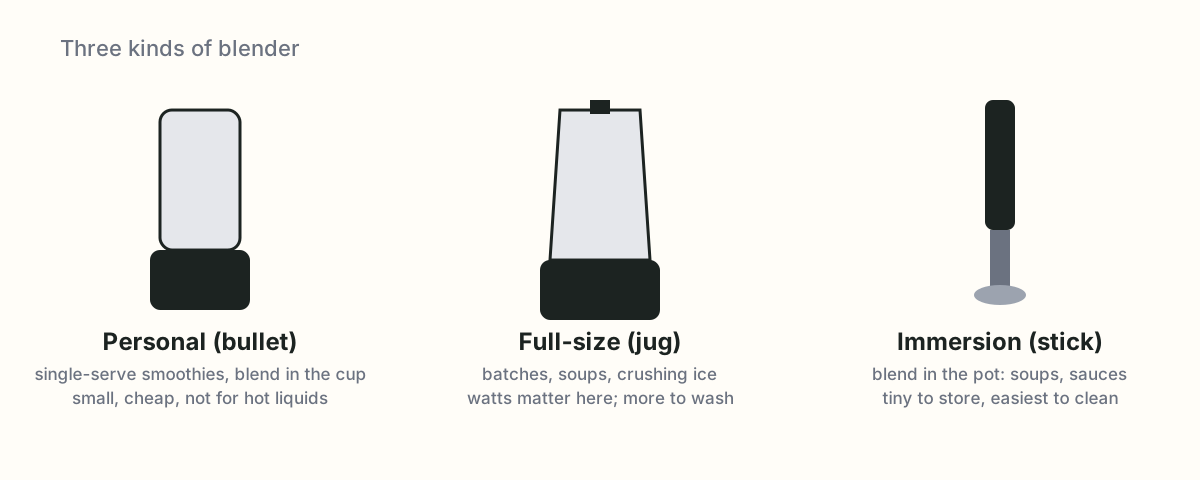
Short answer: If you mostly make one smoothie at a time, buy a personal (bullet) blender: cheap, small, blend in the cup you drink from. If you make batches, frozen drinks, or anything with ice, buy a full-size jug blender of 600 watts or more. If you mostly make soups and sauces, buy an immersion (stick) blender and blend in the pot. The type matters far more than the brand.
The three types
Personal / bullet blender
A small motor base with a blade cap that screws onto a cup. You blend upside down, then flip the cup, swap the blade for a lid, and drink. Cheap, tiny, nothing to pour out, one cup to wash.
Good for: single smoothies, protein shakes, small batches of dressing or sauce, grinding spices or coffee in a dry cup. Bad at: ice on its own, large batches, hot liquids (sealed cup, steam pressure), anything thick like nut butter.
Look for: 600 watts or more if you use frozen fruit; cups with a drinking lid; a blade assembly that comes apart to clean; a motor that does not run unless the cup is locked.
Full-size / jug blender
A base with a 48- to 72-ounce (1.5 to 2 liter) jug. The all-rounder: smoothies for the family, frozen drinks, soups, batters, sauces, crushed ice.
Good for: batches, ice, hot soups (if rated), anything that needs power. Bad at: small amounts (the blade sits above a single serving and spins air), counter space, washing.
Look for: 600 watts minimum, 1,000+ for ice and nut butter; a jug with a wide base and ridges that fold food back onto the blade; a vented lid cap for hot liquids; a jug that is dishwasher safe; variable speed or at least low, high and pulse. Fixed blades are easier to clean than removable ones but harder to get the last bit out of.
Immersion / stick blender
A motor in a handle with a blade at the end of a shaft. You put the blade into the pot, bowl or jug and blend there.
Good for: soups and sauces in the pot, mayonnaise and dressings, baby food, smoothies in a tall cup, mashed potatoes, whipped cream (with the whisk attachment). Smallest to store, fastest to clean. Bad at: ice, nut butter, large batches that need to be perfectly smooth, anything frozen.
Look for: a detachable shaft (so the blade washes in the sink); a stainless shaft rather than plastic, which lets you blend in a hot pot; a blade guard that stops splashing; a beaker included; at least 200 watts. Attachments (whisk, mini chopper) are useful if included and not worth paying much extra for.
Watts: what they mean
| Watts | What it handles |
|---|---|
| 200 to 300 | Soft fruit, soups, sauces, dressings |
| 500 to 700 | Frozen fruit, some ice with liquid, thick smoothies |
| 900 to 1,200 | Ice on its own, nut butter, hot soup from raw vegetables |
| 1,400+ | Daily heavy use, very smooth green smoothies, flour from grains |
Watts are the motor’s input, not its output, and makers quote them generously. A well-designed 600 W blender with a good jug shape beats a badly designed 1,000 W one. Use the number as a floor, not a ranking.
Blades and jug shape
Blending works when food keeps falling back onto the blades. A jug that tapers toward the bottom, with ridges inside, does that; a straight-sided jug leaves a layer spinning above the blade. Blunt, thick blades are normal on blenders (they smash rather than cut) and do not need to be sharp.
For personal blenders, a cross-shaped four-prong blade handles frozen fruit better than a flat two-prong one.
Noise
All blenders are loud; the powerful ones are very loud. If you blend before the rest of the house is awake, a personal blender or an immersion blender in a tall cup is quieter than a full-size one, and a full-size one on a folded towel is quieter than one on a bare counter.
Cleaning
A jug blender cleans itself: half-fill with warm water, a drop of dish soap, run for 20 seconds, rinse. A personal blender’s blade cap comes apart; rinse it straight away, because dried smoothie in the threads is miserable. An immersion blender’s shaft rinses under the tap in seconds. Sugary smoothies left for an hour are the main reason any blender becomes unpleasant.
Which one to buy
- One person, smoothies most days: personal blender.
- Family, frozen drinks, ice, batches: full-size jug, 600 W or more.
- Soups, sauces, small kitchen, little storage: immersion blender.
- Not sure: an immersion blender first. It is the cheapest, takes no space, and does more than people expect. Add a jug blender later if ice and batches turn out to matter.
FAQ
How many watts does a blender need?
For smoothies with soft fruit, 300 watts is fine. For frozen fruit and ice, 600 watts and up. For nut butter, crushing ice to snow and hot soups in the jug, 1,000 watts and up. Watts are a rough guide; blade design and jug shape matter as much.
Can a personal blender crush ice?
Most budget ones can crush a few cubes mixed with liquid, and struggle with a cup of ice on its own. If frozen drinks are the point, buy a full-size blender with a higher-wattage motor.
Can I blend hot soup in a blender?
In an immersion blender, yes, in the pot. In a jug blender, only if it is rated for hot liquids, and then in small batches with the lid vented, because steam builds pressure and blows the lid off. Never in a sealed personal blender cup.
Glass or plastic jug?
Glass does not scratch or hold smells but is heavy and can break. Plastic (usually Tritan) is light and tough but scratches and clouds over years. At budget prices, plastic is the common choice and it is fine.
Is an immersion blender a substitute for a regular blender?
For soups, sauces, smoothies with soft fruit and small jobs, yes. It cannot crush ice, make nut butter, or blend a large batch smoothly. Many kitchens own an immersion blender and nothing else and are happy.