How-to · Knives
How to Choose a Cutting Board: Wood vs Plastic vs Bamboo

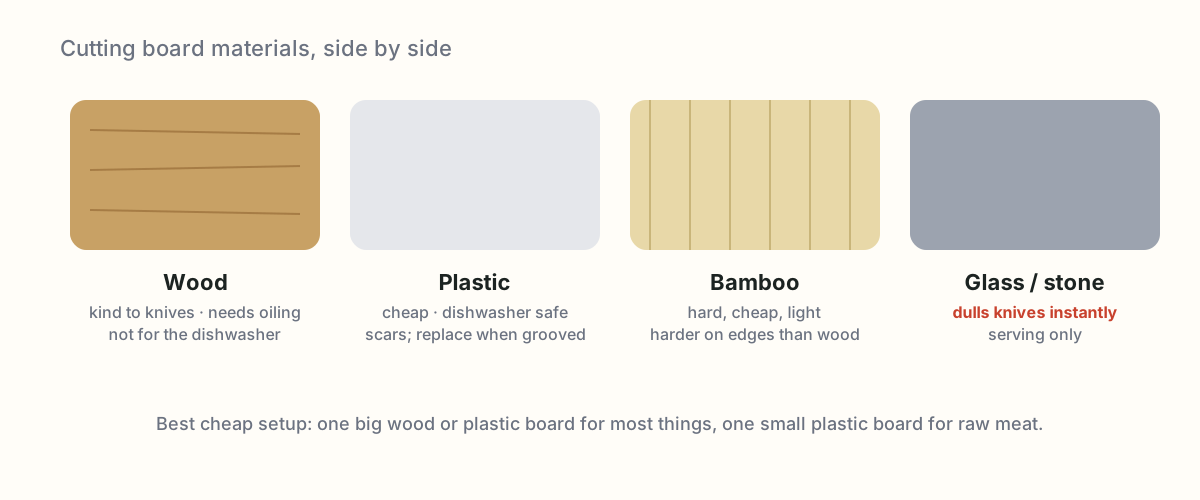
Short answer: Buy a large wood board (maple, walnut, cherry, or an edge-grain board of any hardwood) for everyday cutting, and a small plastic board for raw meat because it can go in the dishwasher. If wood is out of budget, a thick plastic board is fine for everything. Avoid glass, stone, marble and ceramic boards entirely: they dull a knife within a few cuts. Go bigger than you think you need, at least 12 by 18 inches.
Why the board matters for your knives
Every cut ends with the edge hitting the board. A board that gives a little (wood, plastic) lets the edge land softly; a board that does not (glass, stone) rolls or chips the edge on contact. A good board can double the time between sharpenings. A glass board can undo a fresh sharpening in one meal.
Wood
The traditional choice and the best one for knives. Hardwoods with a closed grain (maple, walnut, cherry, beech) are kind to edges, do not splinter, and last for decades.
- Edge grain boards (strips of wood side by side) are the common, affordable type. Good for knives, easy to care for.
- End grain boards (a checkerboard of wood ends) are the kindest to knives, because the edge slips between the wood fibers. They cost more and need more oiling.
- Avoid soft woods (pine) that gouge, and oak, whose open grain traps food.
Care: wash with hot soapy water, dry at once standing on edge, oil monthly with food-grade mineral oil. Never soak, never dishwasher.
Plastic
Cheap, light, dishwasher safe, and still kind to knives when new. The downside is that knife cuts scar it, and a deeply grooved board traps food and is hard to clean. Replace it when the surface is heavily scored.
Thick boards (½ inch / 12 mm and up) last longer and do not warp in the dishwasher. The thin flexible mats are handy for transferring chopped food to a pan but wear out fast.
Plastic is the right choice for raw meat and fish, because a dishwasher cycle sanitizes it. Many people keep a color-coded small plastic board just for meat.
Bamboo
Technically a grass, pressed into boards with glue. It is cheap, light, and resists water well, which makes it popular. The catch is that it is harder than maple, so it dulls knives faster. Not a disaster, but if you are choosing between a bamboo board and a wood board at the same price, take the wood.
Composite (wood-fiber) boards
Pressed wood fiber with resin, often sold as dishwasher-safe and knife-friendly. They sit between plastic and bamboo for hardness, do not warp, and are thin and light. A reasonable one-board solution for a small kitchen, slightly harder on edges than wood.
Glass, stone, marble, ceramic
These are not cutting boards. They are serving platters sold as cutting boards. The edge of a knife hits a surface harder than itself and rolls or chips immediately. If you own one, keep it for cheese and bread, and never let a good knife touch it.
Size
The single most common cutting board mistake is buying one too small. On a small board, chopped food spills off the sides, you work in a cramped space, and you end up cutting on the counter.
| Board | Size | Use |
|---|---|---|
| Main board | 12 × 18 in (30 × 45 cm) or larger | Everything |
| Meat board | 8 × 12 in (20 × 30 cm) plastic | Raw meat and fish |
| Small board | 6 × 9 in (15 × 23 cm) | A lemon, a clove of garlic |
Thickness matters for wood: 1 inch (2.5 cm) and up stays flat. Thin wood boards warp.
How many boards
Two is the practical minimum: a big everyday board and a plastic board for raw meat. A third small one for quick jobs is a convenience. More than that is clutter.
Keeping the board still
A board that slides is dangerous. Put a damp towel or a piece of non-slip shelf liner under it. Some boards have rubber feet, which work, but those boards are one-sided; a plain board can be flipped.
Care summary
| Wood | Plastic | Bamboo | |
|---|---|---|---|
| Wash | Hot soapy water, dry on edge | Dishwasher fine | Hot soapy water, dry on edge |
| Oil | Monthly, mineral oil | No | Monthly, mineral oil |
| Deodorize | Coarse salt and half a lemon, scrub | Baking soda paste | Salt and lemon |
| Replace when | Deeply cracked or warped | Deeply scored | Splitting at the glue lines |
With a decent board and the right grip, a sharp knife stays sharp for months. With a glass board, it does not stay sharp for a meal.
FAQ
Is a wood or plastic cutting board better?
Wood is kinder to knife edges and lasts for decades with a little oil. Plastic is cheap, light and dishwasher safe, which makes it the sensible choice for raw meat. Most kitchens are best with one of each: a large wood or plastic board for everyday use and a small plastic one for meat.
Is bamboo good for knives?
It is harder than most wood, so it dulls knives faster than maple or walnut, though nowhere near as fast as glass. It is cheap, light and resists water, so it is a reasonable budget choice; just expect to sharpen a little more often.
What size cutting board should I get?
Bigger than you think. At least 12 by 18 inches (30 by 45 cm) for a main board, so chopped food has somewhere to go. A board that is too small is the most common reason food ends up on the counter.
Is it safe to cut raw chicken on a wood board?
Yes, if you wash it with hot soapy water right after and let it dry. Studies have found wood no worse than plastic for bacteria. The practical reason to use plastic for meat is that it can go in the dishwasher, which is easier.
How do I keep a wood board from warping?
Never soak it or put it in the dishwasher, dry it standing on edge so both sides dry evenly, and oil it with food-grade mineral oil monthly. Warping comes from one side getting wetter than the other.