How-to · Knives
Which Kitchen Knives Do You Actually Need? (Three, Not Twelve)

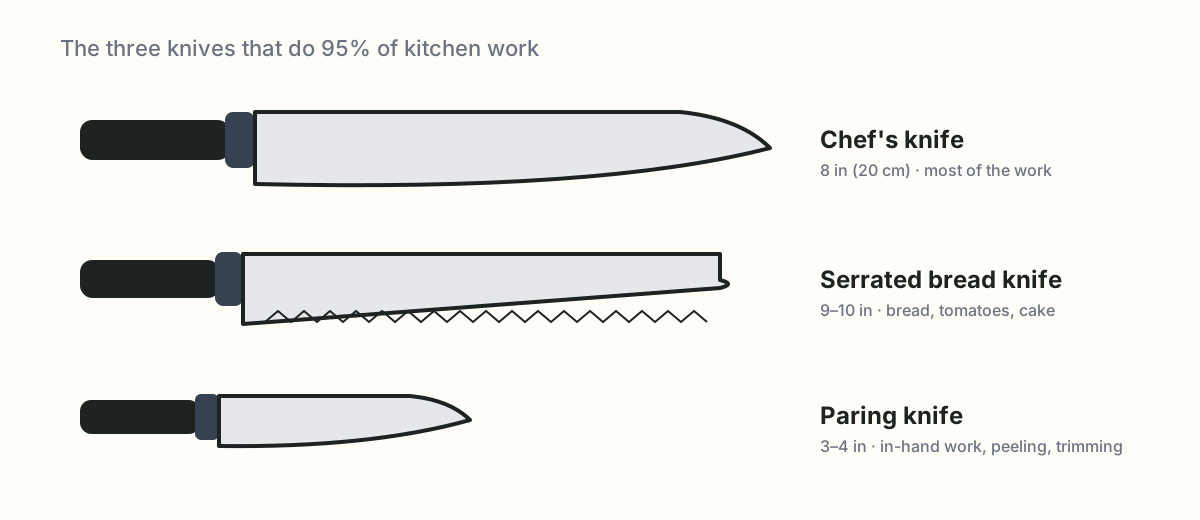
Short answer: Three knives do nearly everything: an 8-inch chef’s knife (or a santoku), a serrated bread knife, and a paring knife. Buy those three individually, spend most of the budget on the chef’s knife, and skip the block set. Add a boning knife and a longer slicing knife only if you find yourself needing them.
The three
1. Chef’s knife (8 inch / 20 cm)
This is the knife. Chopping vegetables, slicing meat, mincing herbs and garlic, breaking down a chicken, cutting a melon. If you do 90% of your cutting with one knife, this is the one, and it is where the money should go. A 7-inch santoku does the same job with a flatter blade and lighter weight; our chef’s knife vs santoku guide helps you choose. For what to look for in a cheap one, see how to choose a budget chef’s knife.
2. Serrated bread knife (9 to 10 inch / 23 to 25 cm)
Serrations saw through crusts and skins that a straight edge would crush: bread, tomatoes, citrus, cakes, melons with hard rinds. The teeth also mean it stays useful for years without sharpening. Longer is better; a short serrated knife cannot get through a wide loaf in one stroke. This can be the cheapest of the three, because budget serrated knives work almost as well as expensive ones.
3. Paring knife (3 to 4 inch / 8 to 10 cm)
For work done in the hand rather than on the board: peeling, coring, trimming, hulling strawberries, segmenting an orange, deveining shrimp. Cheap paring knives are fine and easy to sharpen; some cooks buy two or three inexpensive ones and treat them as semi-disposable.
The two worth adding later
Boning knife (5 to 6 inch, thin, slightly flexible). If you break down whole chickens or trim meat often, this gets into joints and along bones in a way the chef’s knife cannot. If you do it twice a year, the paring knife manages.
Slicing or carving knife (10 to 12 inch, thin). For roasts, whole fish, and anything where you want long, even slices in one stroke. A chef’s knife does it adequately; a slicer does it better. Worth it if you roast often.
What you do not need
- The block set. Twelve knives for the price of two good ones means each is mediocre, and nine of them will never leave the block.
- A utility knife. The “in-between” knife in every set. The chef’s knife and paring knife cover its range between them.
- A santoku and a chef’s knife. One or the other to start; the second is a luxury.
- A meat cleaver. For bones. Most home cooks never need one.
- Steak knives, cheese knives, tomato knives, decorating knives. Table knives and novelties.
- An electric knife. A serrated bread knife does the same thing without the cord.
How to spend a budget
Put roughly 60% of the budget into the chef’s knife, 25% into the bread knife, and 15% into the paring knife. The chef’s knife is the one you hold for hours; the other two are used for minutes. A good chef’s knife plus two inexpensive but decent supporting knives beats three middling ones.
Then put a little aside for a whetstone and a honing rod. A sharp cheap knife outperforms a dull expensive one, and keeping knives sharp is what makes the small set enough.
Looking after three knives
- Hand wash, dry at once, store in a drawer guard, on a magnetic strip, or in a block. Loose in a drawer, they bang against each other and dull.
- Hone the chef’s knife weekly; sharpen it every few months.
- Sharpen the paring knife when the chef’s knife gets its turn.
- The bread knife needs nothing for years. When it finally dulls, replace it; sharpening serrations is a specialist job.
The three-knife test
Before buying anything else, cook for a month with these three and notice what you reach for and when you wished for something different. Most people never find a gap. The few who do (a lot of whole chickens, a lot of roasts) will know exactly which fourth knife they need.
FAQ
Are knife block sets worth it?
Rarely. You pay for eight to twelve knives and use three. The money spread across the set means each knife is worse than the one you could have bought alone. Buy a good chef’s knife, a bread knife and a paring knife separately for the same price.
What is the one knife to buy if I can only buy one?
An 8-inch chef’s knife, or a 7-inch santoku if your hands or board are small. Either does 90% of kitchen cutting on its own.
Do I need a boning knife?
Only if you break down whole chickens or trim large cuts of meat regularly. For the occasional chicken, a paring knife and kitchen shears do the job.
What about steak knives?
They are table knives, not kitchen knives. A set is nice if you eat steak often; cheap serrated ones work fine and never need sharpening. They have no place in this list because they are not for cooking.
Should I buy a cleaver?
A heavy meat cleaver is for bones and is rarely needed at home. A Chinese vegetable cleaver (cai dao) is a different thing: a thin, light, rectangular blade that many cooks use as their main knife. If that shape appeals, it can replace the chef’s knife entirely.