How-to · Gadgets
How to Choose a Nonstick Pan (and When to Replace It)

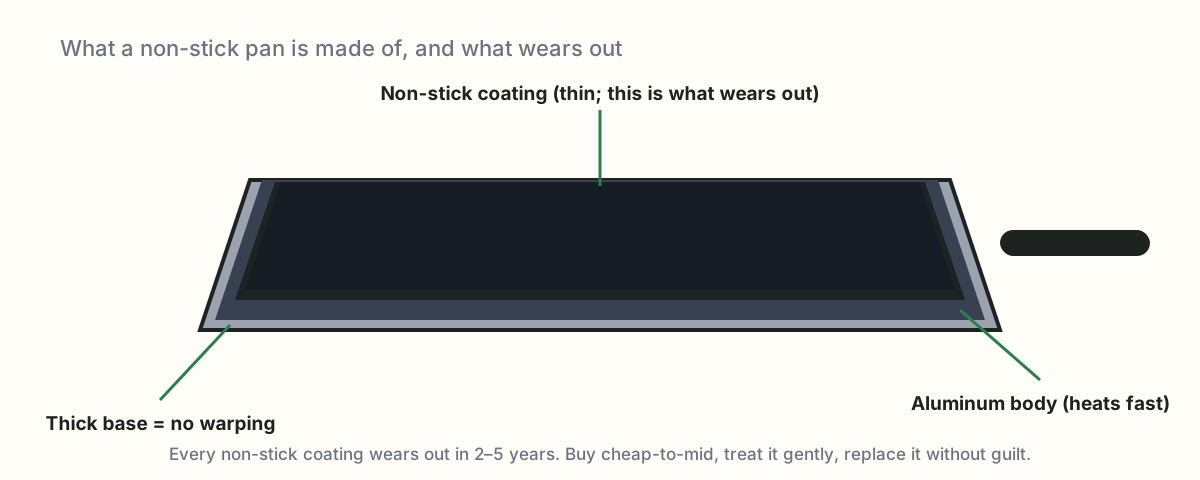
Short answer: Buy a 10- or 12-inch (25 to 30 cm) nonstick skillet with a thick, flat base, a PTFE coating, a riveted handle that is oven-safe to at least 350 °F, and a lid if you can get one. Do not spend a lot: every nonstick coating wears out in a few years no matter the price. Cook on medium or lower, use silicone or wooden tools, hand wash, and replace it when food starts sticking or the coating flakes.
What nonstick is for
Eggs, pancakes, crepes, delicate fish, and anything you want to cook with little fat and no sticking. It is the pan for low and medium heat. It is not the pan for searing steak, blackening, or high-heat stir-frying; the coating breaks down above about 500 °F (260 °C), and nonstick does not build the browned crust that a bare metal pan does. Our which pan to buy first guide explains how nonstick, stainless and cast iron divide the work.
The coating
PTFE (the family that includes Teflon) is the standard. It is the slickest, lasts the longest, and is what most pans use. Multiple layers (“3-layer,” “5-layer”) last a little longer than single-layer coatings; the layer count matters more than the brand name of the coating.
Ceramic-type (sol-gel) coatings are sold as PTFE-free. They start out very slippery and lose it faster, often within a year, and tolerate high heat less well. If you want to avoid PTFE they are the option; otherwise PTFE is the better value.
“Diamond,” “granite,” “stone” and similar are marketing names for PTFE coatings with hard particles mixed in. They may wear slightly better; they are not a different technology.
The body under the coating
This is where a cheap pan and a bad pan differ.
- Thickness. A thin pan warps on a hot burner, and a warped pan has oil pooling at the edges and a hot spot in the middle. Look for a base thickness of 3 mm or more, or just pick up the pan: a heavier pan of the same size has a thicker body.
- Flat base. Put it on a flat counter; it should not rock. Essential on induction and glass-top stoves.
- Aluminum is the normal body, light and fast to heat. Hard-anodized aluminum is harder and more dent-resistant; a small upgrade worth having if the price is close.
- Induction base (a steel plate on the bottom) if you have or might get an induction stove. Check with a magnet: if it sticks, the pan works on induction.
Size and shape
| Size | Good for |
|---|---|
| 8 in (20 cm) | One or two eggs, a single omelet |
| 10 in (25 cm) | The everyday size for one to two people |
| 12 in (30 cm) | Family cooking, four portions, stir-fries |
Sloped sides make it easy to slide food out and flip; a flat cooking surface of at least 8 inches on a 10-inch pan gives room to work. Very deep sides make a sauté pan, which is useful but is a different pan.
Handle and lid
- Riveted handles are more secure than screwed ones, which loosen over time.
- Stay-cool handles (hollow stainless or silicone-wrapped) matter if you cook on gas.
- Oven-safe to at least 350 °F (175 °C) lets you finish a frittata under the broiler. Many budget pans have plastic handles rated to 350; all-metal handles go higher.
- A lid is worth having for steaming vegetables and finishing eggs. Glass lids let you see; a lid from another pan of the same size works too.
Things that are not worth paying extra for
- Brand-name coatings. Same chemistry.
- Copper-colored or “stone-look” finishes. Cosmetic.
- Sets of six or eight nonstick pans. You will wear out the two you use and store the rest. Buy one or two pans.
- “Lifetime” warranties on the coating. The coating will not last a lifetime, and claims are a hassle.
Making it last
- Medium heat or lower. Nonstick does not need high heat and is damaged by it. Never preheat an empty nonstick pan on high.
- A little oil or butter. Even on nonstick; it protects the coating and improves browning. Aerosol sprays leave a sticky film that builds up; use a bottle or a brush.
- Silicone, wood or nylon tools. Metal scratches.
- Hand wash with a soft sponge. Dishwasher detergent is abrasive and the heat cycles age the coating.
- Let it cool before washing; cold water on a hot pan warps it.
- Store with a cloth or paper towel between stacked pans so other pans do not scratch it.
When to replace it
- Eggs stick even with butter.
- The coating is flaking or peeling, or there are scratches through to the metal.
- The base is warped and rocks on the stove.
A worn surface that is dull but still releases food is fine to keep using. Flaking is the signal: once the coating lifts, it comes off into the food. Small flakes are considered harmless if swallowed, but a flaking pan has reached the end.
FAQ
Is nonstick cookware safe?
Current PTFE (Teflon-type) coatings are considered safe for normal cooking. The coating breaks down above about 500 °F (260 °C), which is why makers say not to preheat an empty nonstick pan on high and not to use it for searing. PFOA, the chemical that caused earlier concern, has not been used in these coatings for over a decade.
Ceramic or PTFE nonstick?
PTFE stays slippery longer and tolerates metal utensils slightly better. Ceramic-type coatings start very slick but lose their nonstick faster, often within a year, and are more sensitive to high heat. At budget prices, PTFE is usually the better buy; choose ceramic if you prefer to avoid PTFE.
How long does a nonstick pan last?
Two to five years with gentle use. Scratches, high heat and the dishwasher shorten that. Treat a nonstick pan as something you will replace, and spend accordingly.
Can I use metal utensils on nonstick?
Better not. Even coatings sold as ‘metal utensil safe’ scratch over time. Silicone, wood or nylon tools are cheap and extend the pan’s life by years.
When should I throw away a nonstick pan?
When food sticks despite oil, when the coating is visibly flaking or peeling, when there are deep scratches down to the metal, or when the pan is warped and rocks on the burner. A dull, slightly scratched surface that still releases eggs is fine.