How-to · Knives
How to Dice an Onion (Without Crying)

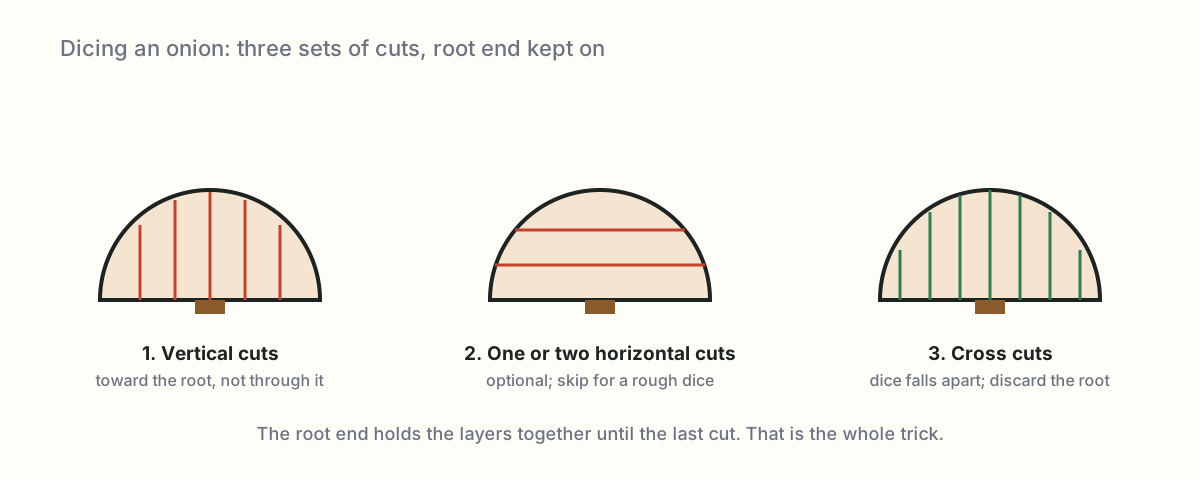
Short answer: Cut off the stem end, leave the root on, halve the onion through the root, and peel. Lay a half flat and make vertical cuts from the stem end toward the root, stopping just short of it. Then cut across those lines, and the onion falls into dice. The root end holds everything together until the last cut, which is the whole trick. A sharp knife and a chilled onion are what keep the tears down.
Before you cut
- Sharpen the knife. A sharp blade slices through the onion’s cells; a dull one crushes them, which releases far more of the gas that makes you cry. If your knife is dull, nothing else on this page helps much.
- Chill the onion for 30 minutes in the fridge if you have time. Cold slows the reaction.
- Ventilate. A window, a fan, or the stove hood on.
- Use the pinch grip and the claw. The onion is the classic thing to practice them on; see how to hold a chef’s knife.
Step 1: Cut off the stem end, keep the root
Put the onion on its side. Cut off the stem end (the pointed, dry end) about ¼ inch in. Leave the root end (the flat, hairy end) on. The root is what holds the layers together while you cut; it comes off last.
Trim the hairy roots flush if they are long, but do not cut into the root itself.
Step 2: Halve and peel
Stand the onion on the cut stem end and slice straight down through the root, so each half has part of the root. Peel the papery skin and the first slimy layer off each half, pulling toward the root. It comes away easier from a half than from a whole onion.
Step 3: Vertical cuts
Put a half flat side down, root end away from you (or to the side, if that is more comfortable). With the claw hand holding the onion and the blade tip pointing at the root, make vertical cuts from the stem end toward the root, stopping about ¼ inch before it so the half stays attached.
Angle the cuts like spokes toward the center of the onion rather than straight down, because the onion is round; this keeps the pieces even. Space the cuts to match the dice size you want: ¼ inch apart for a medium dice, closer for fine.
Step 4: Horizontal cuts (optional)
For a very fine, even dice, turn the knife flat and make one or two horizontal cuts through the half, parallel to the board, again stopping before the root. Keep your other hand flat on top of the onion, fingers well back from the blade.
For everyday cooking, skip this. The onion’s own layers already divide it horizontally, and the spoke-angled vertical cuts do the rest.
Step 5: Cross cuts
Now cut across the vertical cuts, from the stem end toward the root, at the same spacing. The onion falls apart into dice as you go. When you reach the root, you are left with a small piece holding the ends of all the layers; discard it or save it for stock.
Repeat with the other half.
Sizes
| Cut | Size | Use |
|---|---|---|
| Large dice | ½ in (12 mm) | Stews, roasting |
| Medium dice | ¼ in (6 mm) | Most recipes that say “diced” |
| Small dice | ⅛ in (3 mm) | Sauces, salsa, dressings |
| Minced | As fine as possible | Where the onion should disappear |
| Sliced | Thin half-moons | Caramelized onions, salads, fajitas |
For slices instead of dice, skip the vertical and horizontal cuts: just cut across the half from stem to root, as thin as you like.
What works against the tears, and what does not
Works:
- A sharp knife. The biggest factor.
- Chilling the onion first.
- Cutting the root end last, which is where the irritant is most concentrated.
- Ventilation, or cutting next to the stove hood.
- Swimming goggles or onion goggles. They look silly and they work completely.
- Contact lenses, if you wear them; they shield the eye.
Does not work, or barely:
- A spoon or bread in your mouth.
- A lit candle nearby.
- Holding your breath.
- Cutting under running water (it works, but you are now cutting a wet onion with a wet knife on a wet board).
Practice
One onion a day for a week and the whole sequence takes under a minute. If the dice comes out uneven, slow down on the vertical cuts; that is where the spacing is set. A knife that drags or crushes needs the whetstone before it needs practice.
FAQ
Why do onions make you cry?
Cutting cells releases an enzyme that forms a gas (syn-propanethial-S-oxide) which irritates your eyes. The more cells you crush, the more gas; a sharp knife cuts cleanly and crushes less, which is why a dull knife makes it worse.
What actually stops the tears?
A sharp knife, chilling the onion for 30 minutes first, cutting the root end last, and good ventilation (a fan or open window). Swimming goggles work too and are not as silly as they sound. Running water nearby helps a little; a spoon in the mouth and a slice of bread do nothing.
What is the difference between diced, chopped and minced?
Size. A medium dice is about ¼ inch (6 mm) cubes; a small dice about ⅛ inch (3 mm); minced is as fine as you can get. ‘Chopped’ means roughly cut without worrying about even size.
Do I need the horizontal cuts?
No. The vertical cuts, angled toward the center of the onion like spokes, do most of the work, and the onion’s own layers provide the horizontal divisions. Skip the horizontal cuts for a quick everyday dice; add one for a very fine, even dice.
How do I store half an onion?
Wrapped tightly or in a sealed container in the fridge, for up to a week. Cut onions pick up fridge smells and give off their own, so a container is better than cling film.